RFID Frequencies: LF, HF, UHF & Microwave
RFID operates in several frequency bands, and the band decides range, speed, behaviour near metal and water, cost and which standards apply. This chapter explains LF, HF (including NFC), UHF and microwave RFID, lists the regional UHF bands including India's 865-867 MHz, and gives a practical method for choosing.
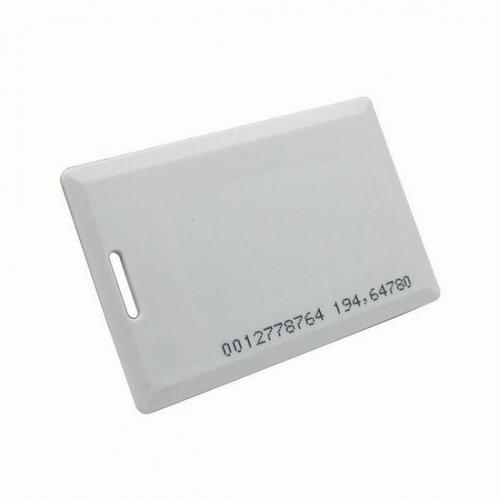
- LF (125/134.2 kHz) has short range and low speed but copes well with water and animal tissue; it is used for animal ID, immobilisers and older access cards.
- HF (13.56 MHz) covers contactless cards, library tags and NFC, with ranges from a few centimetres to about a metre.
- UHF (860-960 MHz) passive RFID reads many tags fast at several metres; India uses 865-867 MHz, the USA 902-928 MHz.
- Microwave (2.45 GHz) RFID is mostly active and niche; active tags also commonly use 433 MHz.
- Choose the band from required range, number of tags, materials, standards you must follow and budget, then test on real items.
Why frequency matters
"RFID" is not one technology but a family of systems working at very different radio frequencies. The frequency decides how the reader and tag couple (magnetically or by radio waves), how far a tag can be read, how fast data moves, how many tags can be read per second, how metal and water affect the signal, how big the tag antenna must be, and which standards and regulations apply. A tag and reader must use the same band and protocol; a 125 kHz access card is invisible to a UHF reader and vice versa.
The four main groups are:
- LF (low frequency): 125 kHz and 134.2 kHz
- HF (high frequency): 13.56 MHz, including NFC
- UHF (ultra-high frequency): 860-960 MHz for passive tags, plus 433 MHz for many active tags
- Microwave: mainly 2.45 GHz, and 5.8 GHz in some toll systems
As explained in How RFID Works, LF and HF systems use inductive (magnetic near-field) coupling, while UHF and microwave systems use radio waves and backscatter (or an active transmitter). That single difference explains most of the behaviour described below.
LF RFID: 125 kHz and 134.2 kHz
Low-frequency RFID is the oldest commercial band. Tags use a coil antenna, often wound copper wire around a ferrite core, which is why LF tags are relatively thick for their size.
- Range: typically up to about 10 cm for cards and key fobs; up to around a metre with large antennas and larger tags, for example in livestock systems.
- Data rate: low, typically a few kilobits per second, so reading is slower and only one or a few tags can be handled at a time.
- Metal and water: the long wavelength passes through water, soil and animal tissue well, and LF tolerates nearby metal better than other bands, though metal still reduces range.
- Standards: ISO 11784/11785 define the code structure and air interface for animal identification at 134.2 kHz (FDX-B and HDX technologies). ISO 14223 extends this for advanced animal tags. Many 125 kHz access cards and fobs use proprietary formats, often read-only.
- Typical uses: pet and livestock identification (glass capsule implants, ear tags, boluses), car immobiliser keys, legacy door access cards, some industrial tool and keg tracking.
In the real world
HF RFID: 13.56 MHz and NFC
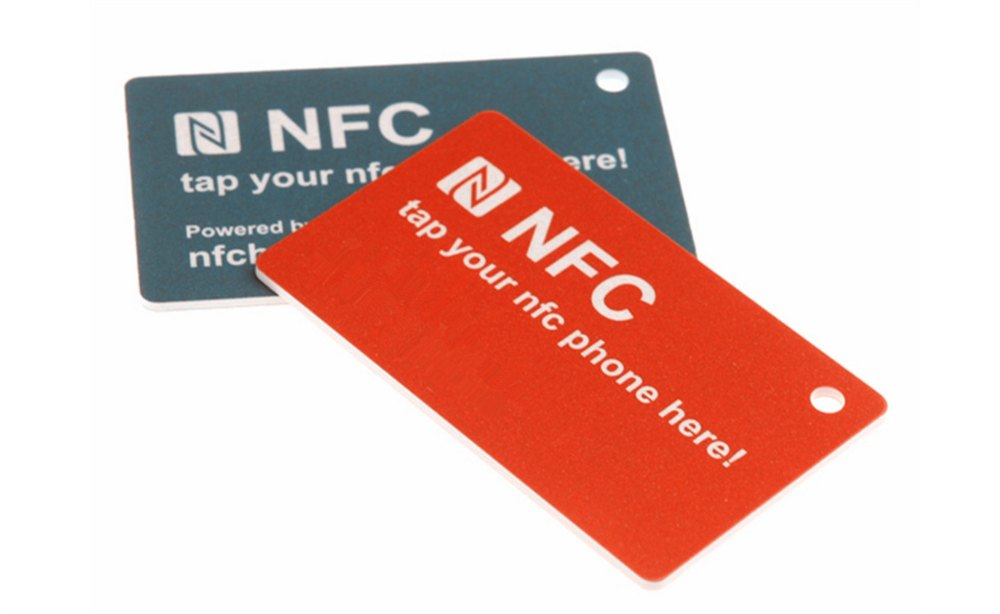
HF RFID at 13.56 MHz uses flat printed or etched coil antennas, so tags can be thin labels, cards and stickers. It is a single worldwide frequency, which simplifies global deployment. There are three main standard families:
ISO/IEC 14443 (proximity)
Designed for contactless smart cards with a range typically up to about 10 cm. Chips range from simple memory types to secure microprocessors that run cryptography. Data rates start at 106 kbit/s and can go higher. Used for transit cards, contactless bank cards, e-passports, secure employee ID and hotel keys.
ISO/IEC 15693 (vicinity)
Designed for longer HF range, typically tens of centimetres and up to about a metre with large gate antennas, at lower data rates. Used for library books, document and file tracking, ski passes, some pharmaceutical and laboratory sample labels, and industrial identification. ISO/IEC 18000-3 also covers HF air interfaces.
NFC (Near Field Communication)
NFC is a set of standards (including ISO/IEC 18092 and NFC Forum specifications) built on 13.56 MHz HF technology for very short-range interaction, typically up to about 4 cm. It is compatible with ISO/IEC 14443 and, in most phones, ISO/IEC 15693 tags. Its great strength is that billions of smartphones are NFC readers, so NFC tags are used for product authentication, smart posters, Wi-Fi pairing, digital business cards, mobile payments and consumer engagement. See NFC tags and HF RFID labels.
- Metal and water: HF works well near water and the human body. Metal close behind the coil disrupts the magnetic field; tags with a ferrite layer are used on metal.
- Multiple tags: HF anti-collision handles several tags in the field, but it is slower than UHF for bulk reading.
UHF RFID: 860-960 MHz
Passive UHF RFID, branded as RAIN RFID and standardised as EPC Gen2 / ISO/IEC 18000-63, is the fastest-growing segment of RFID and the backbone of supply-chain, retail, logistics and asset tracking.
- Range: typically several metres with fixed readers, up to about 10 metres or more for good labels in clean conditions; a few metres with handheld readers. Large rugged tags can go further.
- Speed: high data rates and an efficient anti-collision protocol allow hundreds of tags per second.
- Tag cost: the lowest of any band for simple labels, because the antenna is a single-layer printed or etched dipole.
- Metal and water: the main weakness. Water absorbs UHF energy and metal reflects and detunes it. Special on-metal tags, tags designed for liquids, spacers and careful placement overcome this in most cases.
- Typical uses: retail apparel, warehouse cartons and pallets, returnable containers, IT and fixed asset tracking, vehicle identification (including FASTag), laundry, jewellery, manufacturing work-in-progress, race timing, document files.
Regional UHF bands
The UHF spectrum is allocated differently in each country, so readers must be configured for the local band and power limit. Main allocations for passive UHF RFID include:
| Region | Band used for passive UHF RFID | Notes |
|---|---|---|
| India | 865-867 MHz | Licence-exempt for RFID under WPC rules, up to 4 W EIRP |
| Europe | 865-868 MHz | Higher-power RFID channels between 865.6 and 867.6 MHz (ETSI EN 302 208) |
| USA, Canada, Mexico | 902-928 MHz | Frequency hopping, up to 4 W EIRP |
| China | 920.5-924.5 MHz | A lower band around 840.5-844.5 MHz is also allocated |
| Japan | Around 916.7-920.9 MHz | Licensing conditions depend on power level |
| Australia | Around 920-926 MHz | Check current local class licence |
Regulations are updated from time to time, so always confirm the current rules before deploying in a new country. The chapter on RFID Standards and Regulations covers this in more detail.
433 MHz active RFID
Below the passive UHF band, 433 MHz is widely used for active RFID tags with their own battery and transmitter (ISO/IEC 18000-7 is one standard here). The longer wavelength travels well around obstacles, and ranges of tens to over a hundred metres are typical. Uses include container and vehicle yard tracking and personnel safety systems. Allowed power and duty cycle vary by country.
Microwave RFID: 2.45 GHz and 5.8 GHz
Microwave RFID mostly uses 2.45 GHz (the same unlicensed band as Wi-Fi and Bluetooth), standardised in ISO/IEC 18000-4. Passive microwave tags exist but are rare; most microwave RFID is active or battery-assisted, used for long-range vehicle identification, access to gated communities and parking, and real-time location systems. Some countries use 5.8 GHz DSRC (dedicated short-range communication) transponders for electronic tolling.
- Strengths: small antennas, high data rates, long range when active.
- Weaknesses: strongly absorbed by water and the human body, crowded band with interference from Wi-Fi and other devices, higher tag cost.
Related technologies such as Bluetooth Low Energy beacons and ultra-wideband (UWB) location tags are often used alongside or instead of active RFID for real-time location; these are compared in RFID vs Barcode vs NFC vs BLE.
Frequency comparison at a glance
The figures below are typical for common passive tags (active where stated). Real results depend on the specific tag, reader, antenna and environment.
| Property | LF 125/134.2 kHz | HF 13.56 MHz | UHF 860-960 MHz | Microwave 2.45 GHz |
|---|---|---|---|---|
| Coupling | Inductive (magnetic) | Inductive (magnetic) | Radio wave, backscatter | Radio wave; mostly active |
| Typical range | Up to about 10 cm; up to about 1 m with large antennas | Up to about 10 cm (cards, NFC); up to about 1 m (vicinity) | Several metres; up to about 10 m or more | Several metres passive; tens of metres or more active |
| Data rate | Low | Medium | High | High |
| Bulk reading | Poor; one or a few tags | Moderate | Excellent; hundreds per second | Good |
| Near water | Very good | Good | Poor without special tags | Poor |
| Near metal | Fair | Fair; needs ferrite tags on metal | Poor without on-metal tags | Poor to fair |
| Global frequency | Yes | Yes | No; varies by region | Mostly yes |
| Indicative tag cost (INR) | About ₹20-150 (fobs, cards, glass tags) | About ₹8-50 (labels, stickers); cards more | About ₹3-20 (labels in volume); rugged tags more | Typically ₹1,000 and up (active) |
| Typical uses | Animal ID, immobilisers, legacy access | Payments, transit, ID, libraries, NFC | Retail, logistics, assets, tolling, laundry | Long-range vehicle access, RTLS |
Indicative costs vary widely with volume, chip, form factor and conversion, and are given only as a rough guide.
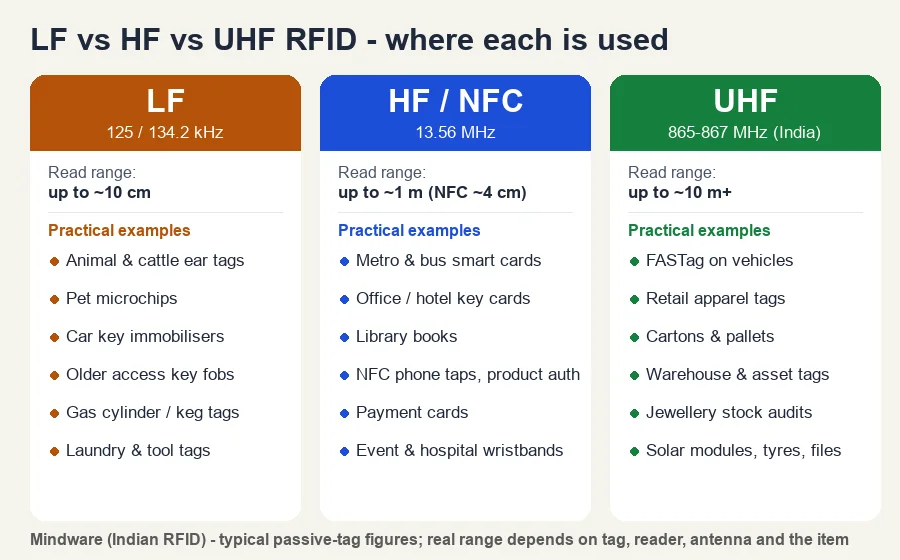
LF vs HF vs UHF - where each is used, with practical examples
| Band | Where it is used | Practical example |
|---|---|---|
| LF 125 / 134.2 kHz a few cm | Animals, car keys, older access fobs, items in or near liquid and metal at short range | Dairy farm: each cow wears an LF ear tag; the reader at the milking point identifies the cow and records her milk yield automatically. Vet clinic: a pet's microchip is read through the skin. Car: the chip in the key lets the engine start. |
| HF / NFC 13.56 MHz cm up to ~1 m | Cards and wristbands, libraries, payments, phone taps, secure ID | Metro or bus: tap a contactless card at the gate. Hotel: the room key card opens the door. Library: books carry HF tags for self check-out and security. Product: a customer taps a phone on an NFC tag to check the product is genuine. Hospital: patient wristbands are read at the bedside. |
| UHF 865-867 MHz (India) up to ~10 m+ | Supply chain, retail, warehouses, vehicles, assets - wherever many items must be read fast and from a distance | Highway toll: FASTag on the windscreen is read as the car passes. Clothing store: staff count thousands of garments in minutes with a handheld reader. Warehouse: a dock-door reader reads every carton on a pallet. Jewellery showroom: the daily stock audit takes minutes instead of hours. Solar plant: each PV module's RFID tag is read for inspection and warranty. |
Quick rule: need to read one item at a time, very close, especially animals or near liquid - LF. Need a card, wristband, phone tap or secure ID - HF / NFC. Need to read many items fast, from metres away - UHF. Tags we make for each band: LF · HF · NFC · UHF · cards & wristbands. Anti-theft systems are different again - see anti-theft EAS vs UHF RFID.
How to choose a frequency
Work through these questions in order. The first one that gives a firm answer often settles the choice.
- Is a standard or ecosystem already set? Animal ID points to LF ISO 11784/11785. Transit, payments and secure ID point to HF ISO/IEC 14443. Retail supply-chain mandates and tolling such as FASTag point to UHF Gen2. Interaction with consumers' phones points to NFC.
- How far away must the tag be read? A deliberate tap means LF or HF; a doorway, conveyor or shelf several metres away means UHF; tens of metres or more means active RFID.
- How many tags at once, and how fast? Counting a carton of 100 garments or a moving pallet calls for UHF.
- What are the items made of? Liquids, animals or the human body favour LF or HF, though modern UHF tags designed for these materials often work with careful placement. Metal assets need on-metal tags in whatever band you choose.
- What is the budget per tag and per read point? For millions of low-value items, the low cost of UHF labels usually wins. For a few hundred high-value assets, tag cost matters less than reliability.
- Is security important? If data must be protected cryptographically, secure HF chips are the mature choice; UHF chips with authentication features exist but are newer.
Once you have chosen a band, the next decision is the tag itself: passive or active, which memory type and which form factor. That is the subject of the next chapter, Types of RFID Tags.
Watch & learn
Videos are from YouTube and their respective creators; they play only when you click.
Help India adopt this fast-growing technology - teach, consult or build projects with Indian RFID.
Frequently asked questions
What is the difference between LF, HF and UHF RFID?
LF (125/134.2 kHz) reads a few centimetres and suits animal ID, car keys and access fobs. HF (13.56 MHz, including NFC) reads from centimetres to about a metre and is used for cards, library books, payments and phone taps. UHF (865-867 MHz in India) reads many tags at once from several metres and is used for FASTag, retail stock, warehouses and asset tracking.
What frequency is used for RFID in India?
Passive UHF RFID in India uses the 865-867 MHz band, which is licence-exempt for RFID within the power limits set by WPC. LF and HF RFID use the same internationally common frequencies as elsewhere, 125/134.2 kHz and 13.56 MHz.
Is NFC the same as HF RFID?
NFC is a specific form of HF RFID at 13.56 MHz, designed for very short-range communication and built into most smartphones. NFC devices can read many ISO/IEC 14443 and ISO/IEC 15693 tags, but NFC is not used for long-range or bulk reading.
Can a UHF tag bought for the USA work in India?
Many UHF tags are designed to work across the whole 860-960 MHz range and perform well in both regions. Others are tuned for one region and read less far elsewhere. Readers, however, must be set to the Indian 865-867 MHz band to be used legally in India.
Which RFID frequency works best near water?
Low frequency (LF) is least affected by water, followed by HF. UHF energy is absorbed by water, so UHF tags on liquids or people need special designs, careful placement or spacers.
Which RFID frequency has the longest range?
For passive tags, UHF has the longest range, typically several metres and up to around 10 metres or more in good conditions. Active tags, often at 433 MHz or 2.45 GHz, reach much further because they have their own transmitter.
Join the 1-month Certified RFID Specialist Program - live online. New batch 12 January 2027.