RFID Chips Explained
The chip is the brain of every RFID tag. This chapter explains what is inside an RFID chip, how its memory is organised, what chip sensitivity means, and compares the major UHF, HF and LF chip families you will meet in real projects.
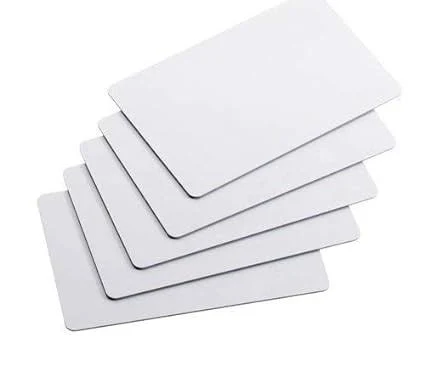
- An RFID chip (IC) contains a radio front end, power harvesting circuit, control logic and non-volatile memory.
- EPC Gen2 UHF chips have four memory banks: Reserved, EPC, TID and User.
- Chip read sensitivity, quoted in negative dBm, strongly influences read range - more negative is better.
- UHF chips are optimised for range and speed, HF chips for security and NFC phones, LF chips for robustness near water and metal.
- Choose a chip by memory, security and sensitivity needs - not by brand name alone - and always test it in a finished tag.
What is inside an RFID chip?
Every passive RFID tag is built around a small silicon integrated circuit (IC), usually called the chip. A modern UHF chip is smaller than a grain of sand - often well under half a square millimetre - yet it contains a complete radio system. When we say a tag is "Monza" or "UCODE" or "MIFARE", we are naming the chip inside it, not the antenna or the label.
A passive chip has no battery, so it must do four things using only the energy it receives from the reader's radio field:
- Power harvesting (rectifier): converts the incoming RF signal into a small DC voltage that runs the chip. This is the most critical block for range - a chip that can wake up on less energy will work further from the reader.
- Demodulator: decodes the commands the reader sends (for example Query, Read, Write).
- Modulator: sends data back. Passive UHF chips use backscatter - they change the impedance seen by the antenna so the reflected signal carries data. HF and LF chips use load modulation of the magnetic field.
- Logic and memory: a state machine that implements the air protocol (EPC Gen2, ISO 14443, ISO 15693 and so on), plus non-volatile memory (usually EEPROM) that keeps data without power. Security chips add cryptographic engines such as AES-128.
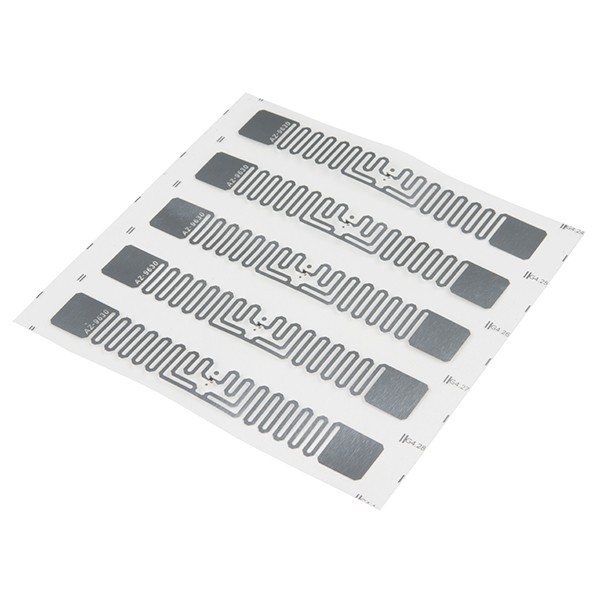
The chip connects to the tag antenna through two pads. The antenna must be impedance-matched to the chip's input, which is why a tag antenna is designed for a specific chip - you cannot freely swap chips on the same antenna and expect identical performance. The antenna side of the story is covered in RFID Antennas & Inlays.
Memory organisation: the four Gen2 memory banks
Passive UHF chips follow the GS1 EPC UHF Gen2 air interface protocol, which is also published as ISO/IEC 18000-63. Gen2 defines four logical memory banks. Understanding them is essential before you encode a single tag.
| Bank | Name | What it holds | Who writes it |
|---|---|---|---|
| 00 | Reserved | 32-bit kill password and 32-bit access password | User (should be set and locked in secure deployments) |
| 01 | EPC | CRC-16, Protocol Control (PC) bits and the EPC identifier - most commonly 96 bits, larger on chips that support it | User / encoder or printer |
| 10 | TID | Chip maker and model identifier; on most modern chips a unique, factory-locked serial number | Chip manufacturer only |
| 11 | User | Optional extra memory for application data (batch, dates, maintenance records) | User - many retail chips have none |
The EPC bank is what a reader reports in a normal inventory. The TID is useful as a tamper-proof serial number: because it cannot be rewritten, systems sometimes pair the EPC with the TID to detect cloned labels. User memory is optional and adds cost; for most supply-chain work a well-structured EPC plus a database lookup is better than storing data on the tag. Encoding schemes such as SGTIN-96 are explained in EPC Encoding & Tag Memory.
HF and LF chips organise memory differently - in blocks, pages or sectors defined by their own standards (for example, MIFARE Classic uses sectors protected by keys; NTAG uses 4-byte pages; ISO 15693 chips use blocks). The principle is the same: a fixed unique ID from the factory, plus user-writable memory with optional locking or password protection.
In the real world
Chip sensitivity and why it matters
Chip datasheets quote read sensitivity and write sensitivity in dBm - the minimum RF power that must reach the chip for it to respond. These are negative numbers, and more negative is better. A chip with -24 dBm read sensitivity wakes up on less energy than one rated at -20 dBm.
Why this matters: in free space, every 6 dB improvement in sensitivity roughly doubles the forward-link range, and every 3 dB improves it by about 40%. That is why each new chip generation advertising "1 or 2 dB better sensitivity" is a meaningful improvement for long-range or difficult applications.
- Write sensitivity is always worse (less negative) than read sensitivity because writing EEPROM needs more energy. Expect encoding range to be shorter than reading range.
- Datasheet sensitivity is for the bare chip. The finished tag's performance also depends on antenna design, matching, size and the material it is attached to. A good chip on a poor antenna is still a poor tag.
- Sensitivity varies slightly across frequency. A tag tuned for 902-928 MHz (USA) may perform worse at 865-867 MHz (India and Europe). Look for "global" inlays or ones tuned for your region.
For the full picture of what controls distance, see RFID Read Range & Performance.
UHF chip families (860-960 MHz)
Almost all passive UHF chips implement EPC Gen2 (ISO/IEC 18000-63), so they work with any Gen2 reader. Differences lie in sensitivity, memory size, special features and price. Four families dominate the market.
Impinj Monza and M-series
Impinj is one of the largest suppliers of UHF chips. The Monza R6 family (R6, R6-P and related variants) became a workhorse for retail and logistics: 96-bit EPC, little or no user memory, good sensitivity, and auto-tuning features that help the tag keep performance on different materials. The M700 series followed with higher sensitivity and a smaller die. Variants differ mainly in memory: the M730 targets high-volume retail with a 128-bit EPC and no user memory, while models such as the M750 and M780 trade some performance for user memory or larger EPC space, and the M770 focuses on sensitivity for demanding retail items. The newer M800 series continues the trend with improved sensitivity and efficiency. Exact memory sizes vary by model - always confirm on the current datasheet.
NXP UCODE
NXP's UCODE line is the other major family. UCODE 8 brought strong sensitivity and features such as brand identification bits. UCODE 9 further improved read sensitivity and is widely used in retail and logistics labels. UCODE DNA is a security chip: it supports cryptographic authentication (AES-128) under ISO/IEC 29167-10, so a reader can verify a tag is genuine rather than a clone. It also offers considerably more user memory than retail chips, making it suitable for vehicle identification, high-value goods and authentication.
Alien Higgs
Alien Technology's Higgs chips have long been popular for general-purpose labels. Higgs-9 is notable for offering a relatively generous user memory together with an expandable EPC, which suits applications that store some data on-tag. Higgs-10 is the newer generation, aimed at higher sensitivity for high-volume retail and supply-chain tagging.
EM Microelectronic
EM Microelectronic (Swatch Group) offers UHF chips and is particularly known for dual-frequency designs such as the EM4423 family, which combine an NFC (13.56 MHz) interface and a UHF Gen2 interface on one chip. One tag can then be read by a warehouse UHF reader and by a consumer's NFC smartphone. EM also makes the EM4325, a UHF chip with an integrated temperature sensor that can run passively or with a battery assist - useful for cold chain.
| Chip family | Standard | User memory (typical) | Security features | Typical uses |
|---|---|---|---|---|
| Impinj Monza R6 family | EPC Gen2 / ISO 18000-63 | None on base R6; small on some variants | Passwords, locking, unique TID | Retail apparel, logistics labels |
| Impinj M700 series (M730, M750, M770, M780) | EPC Gen2 / ISO 18000-63 | None to small, depending on model | Passwords, locking, unique TID, privacy features | Retail, supply chain, asset labels |
| Impinj M800 series | EPC Gen2 / ISO 18000-63 | Model dependent | As M700 | Next-generation retail and logistics |
| NXP UCODE 8 / UCODE 9 | EPC Gen2 / ISO 18000-63 | None on base parts; memory variants available | Passwords, locking, unique TID | Retail, logistics, labels |
| NXP UCODE DNA | EPC Gen2v2 / ISO 18000-63, ISO/IEC 29167-10 | Large (kilobit class) | AES-128 cryptographic authentication | Vehicle ID, anti-counterfeit, high-value assets |
| Alien Higgs-9 | EPC Gen2 / ISO 18000-63 | Moderate (several hundred bits) | Passwords, locking, unique TID | General labels, assets needing on-tag data |
| Alien Higgs-10 | EPC Gen2 / ISO 18000-63 | Small | Passwords, locking, unique TID | High-volume retail, supply chain |
| EM Microelectronic (EM4423, EM4325) | EPC Gen2 (+ NFC on dual-frequency parts) | Model dependent | Passwords; NFC authentication features on some parts | Dual UHF/NFC tags, sensor tags, cold chain |
HF and NFC chip families (13.56 MHz)
HF chips follow either ISO/IEC 14443 (proximity cards, a few centimetres, used by NFC phones and payment cards) or ISO/IEC 15693 (vicinity cards, longer range with larger reader antennas). NXP dominates this segment, though compatible chips exist from other makers.
MIFARE family (ISO/IEC 14443A)
- MIFARE Classic EV1 (1K and 4K memory versions): the most widely deployed access and transit card in the world. Its Crypto1 security is broken, so treat it as an identifier, not as a secure credential.
- MIFARE Ultralight EV1 and Ultralight C: low-cost chips with small memory, used for disposable tickets and event passes. Ultralight C adds 3DES authentication; EV1 offers password protection and an originality signature.
- MIFARE DESFire EV2 and EV3: high-security chips with AES-128, a flexible file system that can host multiple applications on one card, and common memory options of 2, 4 and 8 KB. DESFire EV3 is the current recommendation for new access control, campus and transit cards.
NTAG family (NFC Forum compliant)
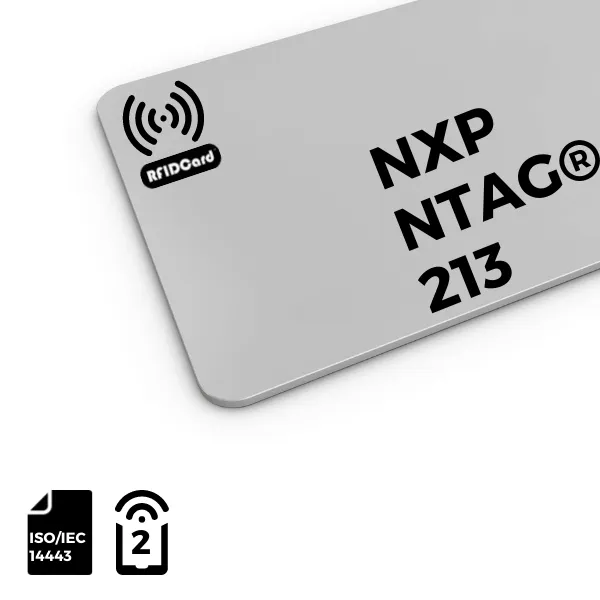
- NTAG 213 / 215 / 216: the standard NFC tags, NFC Forum Type 2. User memory is 144, 504 and 888 bytes respectively. They store NDEF messages such as URLs, and can be read by almost any NFC smartphone.
- NTAG 424 DNA: a secure NFC chip with AES-128 and SUN (Secure Unique NFC) messaging - each tap generates a unique, cryptographically signed URL so a web server can verify that the physical tag is genuine. Popular for product authentication and anti-counterfeiting.
ICODE family (ISO/IEC 15693)
ICODE SLIX2 is widely used in libraries, healthcare and industrial labels because ISO 15693 gives longer range than ISO 14443 (up to roughly a metre with large gate antennas) and good anti-collision. ICODE DNA adds AES-128 cryptographic authentication. ICODE chips are also readable by many NFC phones as NFC Forum Type 5 tags.
| Chip | Standard | User memory (typical) | Security features | Typical uses |
|---|---|---|---|---|
| MIFARE Classic EV1 | ISO 14443A | 1 KB or 4 KB total | Crypto1 (broken) - legacy only | Legacy access, canteen, transit cards |
| MIFARE Ultralight EV1 | ISO 14443A | 48 or 128 bytes | 32-bit password, originality signature | Disposable tickets, event passes |
| MIFARE Ultralight C | ISO 14443A | Small (around 144 bytes) | 3DES authentication | Limited-use tickets |
| MIFARE DESFire EV2 / EV3 | ISO 14443A (ISO 7816-4 commands) | 2, 4 or 8 KB | AES-128, multi-application, secure messaging | Access control, cashless, transit, ID |
| NTAG 213 / 215 / 216 | ISO 14443A, NFC Type 2 | 144 / 504 / 888 bytes | 32-bit password, originality signature | NFC marketing, smart posters, product info |
| NTAG 424 DNA | ISO 14443A, NFC Type 4 | Small file system (a few hundred bytes) | AES-128, SUN authenticated messages | Brand protection, authentication |
| ICODE SLIX2 | ISO 15693, NFC Type 5 | Around 2.5 kbit | Password protection, privacy mode | Libraries, healthcare, industrial labels |
| ICODE DNA | ISO 15693 | Kilobit class | AES-128 authentication | Secure labels, anti-counterfeit |
LF chip families (125-134.2 kHz)
LF chips work at 125 kHz or 134.2 kHz. Range is short (centimetres to tens of centimetres) and data rates are slow, but LF tolerates water, body tissue and nearby metal better than higher frequencies. That makes it the standard for animal identification, many car immobilisers and older access cards.
- EM4100 / EM4102 family: simple read-only chips carrying a 64-bit code (containing a 40-bit unique ID plus header and parity). Extremely common in low-cost proximity cards and key fobs in India. No security - the number is simply broadcast.
- EM4305: a read/write chip with 512 bits of memory, password protection, and support for the ISO 11784/11785 animal ID format (FDX-B). Common in animal tags and industrial ID.
- T5577: a highly configurable read/write chip that can emulate several other LF formats, including EM4100. This flexibility makes it popular for duplicate cards - and is exactly why EM4100-based access control is not secure.
- NXP HITAG: a family including HITAG 1, HITAG 2, HITAG S and HITAG µ. HITAG 2 was widely used in vehicle immobilisers (its cipher has since been broken); HITAG µ supports ISO 11784/11785 and is used in animal and industrial applications.
| Chip | Frequency / standard | Memory | Security | Typical uses |
|---|---|---|---|---|
| EM4100 / EM4102 | 125 kHz, proprietary format | 64-bit read-only code | None | Low-cost proximity cards, key fobs |
| EM4305 | 125-134.2 kHz, ISO 11784/11785 capable | 512 bits read/write | Password | Animal ID, industrial tags |
| T5577 | 125 kHz, configurable | Several 32-bit blocks read/write | Optional password | Rewritable cards, emulation of other formats |
| NXP HITAG family | 125 kHz / 134.2 kHz | Model dependent | Model dependent (HITAG 2 broken) | Immobilisers, animal ID, industrial |
To see these chips in finished products, browse our LF RFID tags, HF RFID labels and UHF RFID labels.
Gen2v2 and security features on UHF chips
The original Gen2 protocol offered only 32-bit access and kill passwords, which travel over the air and are designed for operational control rather than strong security. The Gen2v2 revision (2013) added optional features that newer chips may support:
- Cryptographic authentication using crypto suites defined in the ISO/IEC 29167 series - for example AES-128 on UCODE DNA - so a reader can prove a tag is genuine.
- Untraceable command, which lets a tag hide part of its EPC or TID from unauthorised readers, supporting consumer privacy.
- Memory protection and file management options for structured user memory.
Most retail chips implement only a subset of Gen2v2. If authentication matters to you, specify the exact feature (for example "ISO/IEC 29167-10 AES authentication") rather than just "Gen2v2". Reader support matters too - the reader and middleware must implement the crypto commands.
How to read a chip datasheet
When comparing chips, look for these lines on the datasheet:
- Protocol and standards - EPC Gen2, ISO 14443A, ISO 15693, ISO 11784/11785, NFC Forum type.
- Memory map - EPC size, user memory, TID length and whether TID is serialised.
- Read and write sensitivity (UHF) or minimum operating field strength (HF/LF).
- Data retention and write endurance - commonly many years and tens of thousands of write cycles or more for EEPROM; confirm for your use case if tags will be rewritten often.
- Operating temperature - important for laundry, tyres, cold chain and lamination processes.
- Special features - authentication, privacy modes, auto-tuning, tamper detection, sensors.
Remember that you rarely buy a bare chip. You buy a tag or inlay in which a converter has matched a chip to an antenna for a particular material. The chip determines memory, security and baseline sensitivity; the full tag design determines real-world performance. The next chapter, Which RFID Chip for Which Application, turns this knowledge into practical choices for specific industries.
Watch & learn
Videos are from YouTube and their respective creators; they play only when you click.
Help India adopt this fast-growing technology - teach, consult or build projects with Indian RFID.
Frequently asked questions
What is the difference between an RFID chip and an RFID tag?
The chip is the tiny silicon integrated circuit that stores data and handles the protocol. A tag is the complete product: chip plus antenna plus packaging such as a label, card or hard case.
Which RFID chip has the best read range?
Read range depends on the whole tag, not just the chip, but newer UHF chips with better read sensitivity (such as the latest Impinj M-series and NXP UCODE 9 generation) generally give longer range in the same antenna design.
Is MIFARE Classic still safe for access control?
MIFARE Classic uses the proprietary Crypto1 cipher, which has been publicly broken. It is still common in legacy systems, but new security-sensitive projects should use AES-based chips such as MIFARE DESFire EV2 or EV3.
Can a smartphone read UHF RFID chips?
Ordinary smartphones cannot. Phones contain NFC readers that work at 13.56 MHz with HF chips such as NTAG and MIFARE. Reading UHF chips needs a UHF reader or a phone with an attached UHF RFID sled.
What is a TID and can it be changed?
The TID (Tag Identifier) is a memory bank programmed by the chip maker that identifies the chip model and, on most modern chips, a unique serial number. It is permanently locked and cannot be changed by the user.
Join the 1-month Certified RFID Specialist Program - live online. New batch 12 January 2027.