RFID Blocking Materials: How They Work & Where to Use Them
RFID blocking materials do the opposite of an RFID system: they stop readers from talking to tags and cards. This chapter explains why people and businesses block RFID, how shielding physically works, why frequency matters, which materials and products are used, and how to test whether a sleeve, pouch or shielded room really blocks.
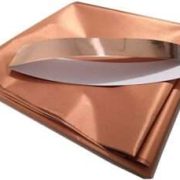
- RFID blocking works on the Faraday cage principle: a continuous conductive layer around a card or tag reflects and absorbs the reader's field so the chip never powers up.
- A fully enclosing pouch or sleeve blocks far better than a single flat sheet; gaps, open ends and cracked seams are where signals leak in.
- HF/NFC (13.56 MHz) and UHF are blocked well by metallised fabrics and foils; LF (125 kHz) is the hardest to block because it couples mainly through a magnetic field.
- Test blocking yourself with a phone NFC app or a reader, checking every side and the opening; labs express shielding as attenuation in dB.
- RFID does not erase cards, and contactless cards already need very close range - blocking is a sensible, low-cost precaution, not a cure for every risk.
What RFID blocking material is
Most of this Academy explains how to make RFID work better - more range, more reliable reads, fewer missed tags. This chapter covers the opposite: materials designed to stop RFID and NFC signals. An RFID blocking material is any layer that prevents a reader's radio field from reaching a tag or card, so the chip never powers up and never answers.
You meet blocking material in everyday products such as card sleeves, wallets and passport covers, and in industrial forms such as shielding fabric sold by the metre, shielding curtains and metal enclosures around encoding stations. The physics is the same in all of them. If you have not yet read how a passive tag gets its energy from the reader, the chapters on RFID frequencies and RFID read range make this chapter easier to follow.
Why block RFID at all?
Blocking is not only about personal privacy. Businesses use shielding at least as much as consumers do. The common reasons are:
- Contactless card and passport concerns - people worry about someone reading a contactless payment card or a chip-enabled passport without permission ("skimming"). Blocking sleeves remove that possibility while the card or passport is inside.
- Protecting access cards - office and hostel access cards, especially older 125 kHz cards with no cryptography, can be copied if read. Keeping them shielded when not in use reduces the opportunity.
- Stopping unwanted reads of tagged inventory - in stores and warehouses, UHF tags on stock near a reader can be read when they should not be, for example items in a back room close to a point-of-sale reader or stock kept beside a dock door portal.
- Shielding encoding stations and test areas - when a printer-encoder or desktop encoder writes tags, nearby tags must not be written by mistake. Shielded boxes, curtains and benches confine the field to the tag being encoded.
- Preventing stray reads near portals - gate and tunnel readers can pick up tags passing on the other side of a wall. Shielding panels or curtains define a clean read zone.
- Privacy for documents - folders and covers keep tagged ID cards, licences or files from being read in transit.
- Shielding sensitive equipment - laboratories and production lines sometimes shield instruments from RF interference generally, of which RFID is only one source.
For the full picture of real RFID threats and how they are defended at the system level, see RFID security & privacy. Blocking is one physical layer of defence; good system design is another.
In the real world
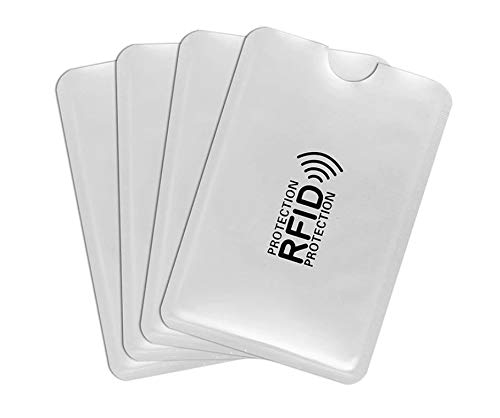
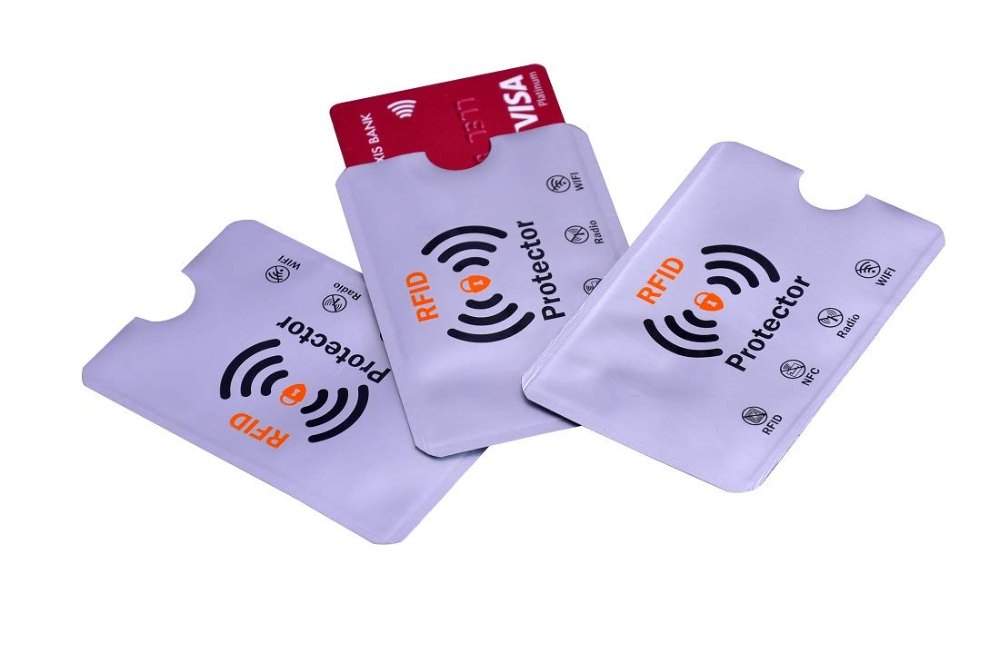
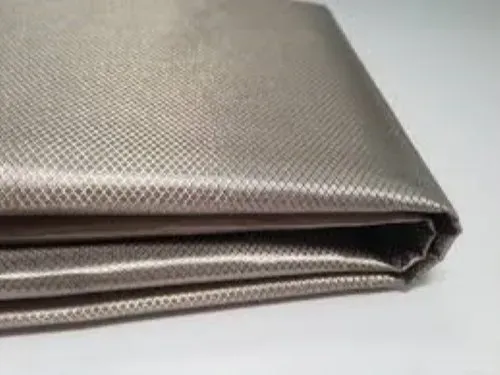
How RFID blocking works: the Faraday cage principle
A Faraday cage is an enclosure made of conductive material. When an electromagnetic wave hits a good conductor, it drives currents in the conductor's surface. Those currents create their own field that opposes the incoming one, so most of the energy is reflected away, and part of what enters the material is absorbed and turned into a tiny amount of heat. Very little gets through to the inside.
A passive RFID tag or contactless card has no battery. It needs to harvest enough energy from the reader's field to wake up. If the shield reduces the field strength below the chip's turn-on threshold, the tag stays silent - it is not hidden or jammed, it is simply never powered.
Which conductors are used
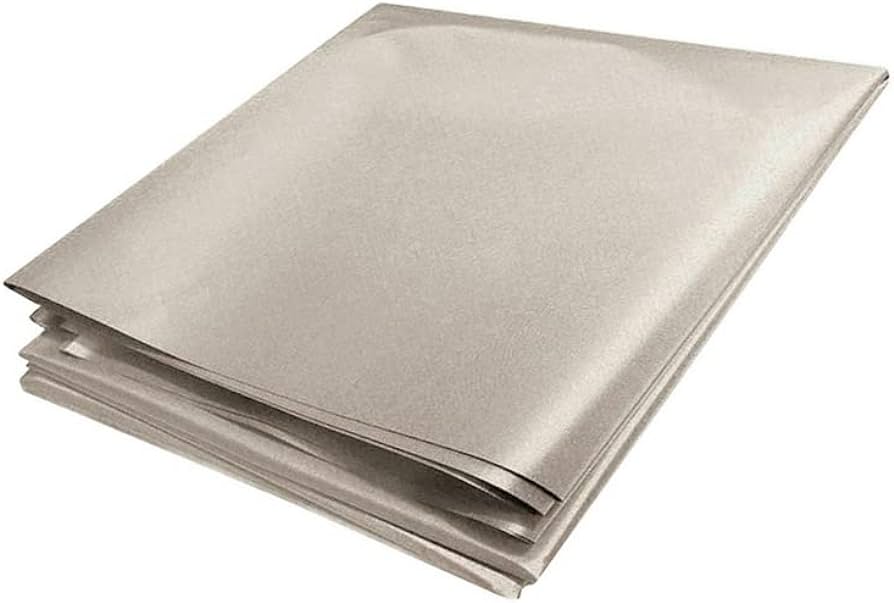
Practical blocking products use thin, flexible conductors: copper, nickel (often copper-nickel together on polyester or nylon fabric), silver-coated fabrics, and aluminium foil laminated to paper or plastic. Copper and silver are excellent conductors; nickel adds corrosion resistance; aluminium is cheap and easy to laminate.
Why a full enclosure beats a single sheet
A single flat sheet only shields the area directly behind it. Radio waves bend around edges, and a reader on the other side, or at an angle, can still reach the card. A pouch, sleeve or box that surrounds the card on all sides forces every path to pass through conductor. That is why a sleeve is far more reliable than a sheet slipped behind a card.
Gaps and seams
A shield is only as good as its weakest opening. Open ends, stitched seams where the conductive layer does not overlap, and cracks in worn fabric all let energy leak in. As a rule of thumb, the higher the frequency, the smaller the gap that matters. Good designs use a flap that folds over the opening, overlapping conductive layers at the seams, or a closure that makes conductive contact.
Frequency matters: LF, HF/NFC and UHF
RFID runs at very different frequencies, and shielding behaves differently at each.
LF (125-134 kHz): the hardest to block
Low-frequency tags, such as many older access cards and animal tags, couple to the reader mainly through a magnetic field at very short range. Low-frequency magnetic fields penetrate thin conductive layers much more easily than higher-frequency fields do, so a thin metallised fabric that easily blocks NFC may only weaken an LF signal. Strong LF shielding needs thicker conductive layers, several layers, or magnetic materials (such as ferrite or high-permeability alloys) that divert the magnetic field around the protected item. In practice, LF read ranges are already short, so even partial attenuation often stops reads, but this must be tested rather than assumed.
HF/NFC (13.56 MHz): blocked well by metallised fabric
Contactless payment cards, metro cards, e-passports and NFC tags all work at 13.56 MHz, again by near-field coupling, but at a frequency where metallised fabric sleeves and foil-laminated cards are very effective. This is the frequency most consumer blocking products are designed for.
UHF (865-867 MHz in India; 860-960 MHz worldwide)
UHF tags are read by far-field radio waves at several metres. In India readers may radiate up to 4 W EIRP (1 W transmitter power) in the 865-867 MHz band. Conductive fabrics and foils block UHF very well when they fully enclose the tag. For industrial uses, where the goal is to stop reflections inside a room or around a portal, RF absorber foam or sheets are used: they soak up energy instead of bouncing it elsewhere, which avoids creating new stray reads.
Types of RFID blocking material
| Material | How it is used | Frequencies | Notes |
|---|---|---|---|
| Metallised nylon or polyester fabric (e.g. copper-nickel, silver-coated) | Wallet and bag linings, pouches, key-fob pouches, fabric by the metre, curtains | HF/NFC and UHF very well; LF partially | Flexible and sewable; performance falls if the coating cracks from repeated folding |
| Aluminium foil laminates | Paper or plastic card sleeves, passport covers, document folders, packaging | HF/NFC and UHF | Low cost and printable; foil can tear or crease at fold lines |
| Conductive films | Thin shielding layers in cards, labels, packaging and enclosures | Mainly HF and UHF | Thin and light; check thickness and coverage |
| RF absorber foam or sheets | Lining portals, test chambers, encoding stations, walls near readers | Mainly UHF and above | Absorbs instead of reflecting, so it reduces stray reflections; bulkier |
| Metal enclosures, shielded boxes and shielding curtains | Encoding and testing stations, labs, storage of tagged stock, room partitions | All bands (LF needs thicker or magnetic material) | Most effective option; doors and joints need conductive gaskets or overlaps |
Common RFID blocking products
For individuals
- Card sleeves - thin paper, plastic or fabric sleeves for single cards; the simplest and cheapest option.
- Wallets and card holders - with a metallised lining sewn in so every card inside is shielded.
- Passport covers - shielded covers for chip-enabled passports.
- Key-fob pouches - for keyless-entry car keys. "Relay attacks" use equipment to extend the communication between a car and a key kept inside a house, so the car believes the key is nearby. Keeping the key in a blocking pouch at home is one common precaution among several; owners should also follow their car maker's advice, and check the pouch actually stops the key working.
- Bags and document folders - for carrying several cards, IDs or tagged documents together.
For businesses and industry
- Shielding fabric by the metre - for lining walls, partitions, cabinets or vehicle compartments.
- Shielding curtains - hung around encoding benches, between dock doors or beside portals to define the read zone.
- Enclosures for encoding and testing - shielded boxes so one tag can be encoded or tested without disturbing others, and so test results are not polluted by outside signals.
How to test RFID blocking
Simple practical test
- First confirm the card or tag reads without the shield, using a phone NFC app (for HF/NFC cards) or an RFID reader for the right frequency.
- Put it fully inside the sleeve, wallet or pouch and try again, holding the phone or reader directly against the product.
- Test every side - front, back, edges - and especially the opening.
- For wallets, test each card slot, not just one.
- For UHF, use a handheld reader at full permitted power and approach from several directions.
A product that blocks at contact distance from every side will block at any realistic distance, because the reader's field gets weaker with distance.
Lab measurement: attenuation in dB
Labs measure how much a material reduces signal strength, called attenuation or shielding effectiveness, in decibels (dB). The dB scale is logarithmic: every 10 dB means the power is reduced ten times.
- 10 dB: power reduced to 1/10
- 20 dB: power reduced to 1/100
- 30 dB: power reduced to 1/1,000
- 60 dB: power reduced to 1/1,000,000
As an indicative guide, good metallised shielding fabrics are typically specified somewhere in the range of several tens of dB at HF and UHF, often 50-80 dB or more for the flat fabric. A finished product with seams and an opening usually performs worse than the raw material, so the figure for the finished pouch is the one that matters. Always ask at which frequencies a figure was measured; a high number at 1 GHz says little about 125 kHz.
Limitations and myths
- Myth: RFID readers can erase cards. They cannot. A reader powers the chip briefly and exchanges data. Cards are not wiped by passing through store gates or near readers.
- Myth: anyone can read your card from across the room. Contactless payment cards and passports work at HF and are designed for very close range, typically a few centimetres. Specialised equipment can stretch this somewhat, but not to large distances, and payment cards use cryptography for each transaction. Chip-enabled passports also require data printed inside the passport before most chip data can be read.
- Blocking "cards" in wallets vary. Single cards that claim to protect a whole wallet behave differently depending on card position and type. Fully enclosing sleeves and linings are more predictable.
- Blocking does not fix weak system security. An insecure 125 kHz access card is still copyable whenever it is out of the sleeve. Upgrading to cryptographic cards is the real fix.
The balanced view: real-world skimming of contactless cards is uncommon, and banks have their own protections, but a blocking sleeve costs little and removes the possibility. It is a sensible precaution, not a necessity driven by fear.
Care and lifetime of blocking products
- Folding and creasing - repeated sharp folds crack foil laminates and the metal coating on fabric. Cracks become gaps.
- Wear - metallised fabric in wallets and pouches rubs against cards and keys; coatings wear thin over months or years of daily use.
- Moisture and washing - some coatings corrode or flake; follow the maker's care instructions.
- Retest periodically - a quick phone NFC test every few months confirms a wallet or pouch is still blocking.
Buying RFID blocking material as a business
Banks, corporates, event organisers and exporters buy blocking products in bulk, often as branded giveaways or to protect cards they issue.
- Bulk material - fabric by the metre or roll, and foil laminate sheets, for in-house conversion or shielding projects.
- Custom-printed sleeves - banks enclosing new debit or credit cards, corporates issuing access cards, and events issuing NFC badges or wristbands often print their logo and instructions on sleeves.
- Custom sizes - card, passport, key-fob, document or device sizes.
- Quality checks - test pre-production samples with the actual cards and tags you use, at each frequency you care about; check seams and openings; sample-test each batch on arrival; and ask for the supplier's test method.
RFID blocking in India
Contactless technology is now part of daily life in India, as covered in RFID in daily life. Typical items people choose to shield include:
- Contactless debit and credit cards - tap-to-pay cards issued widely by Indian banks.
- NCMC metro and transit cards - National Common Mobility Cards used on metro and bus systems.
- Chip-enabled passports - India has begun issuing e-passports with an embedded chip.
- Corporate access cards - in offices, IT parks and factories, many still on 125 kHz LF technology.
For organisations, the same principles apply as anywhere else: identify the frequency, choose a fully enclosing design, and test the finished product.
RFID blocking products made and sold in India by Indian RFID
Indian RFID, the RFID division of Mindware (New Delhi, in barcode and RFID since 1997), makes and sells RFID blocking material and products in India, such as card sleeves, wallets and pouches, and shielding fabric. Custom sizes and printing are available for corporates, banks, events and exporters, with bulk supply across India. See the range on the RFID blocking material page.
If you want to go deeper into RFID technology, including shielding, read zones and testing in real projects, the RFID courses in India from Indian RFID cover these topics in a structured, practical way.
Help India adopt this fast-growing technology - teach, consult or build projects with Indian RFID.
Frequently asked questions
Does RFID blocking material really work?
Yes, a well-made sleeve, wallet or pouch with a continuous metallised layer reliably stops HF/NFC contactless cards and UHF tags from being read. Effectiveness drops if the product has gaps, an open end, or worn and cracked fabric, so it is worth testing with a phone or reader.
Can an RFID reader erase or damage my bank card?
No. Readers only power the chip briefly and exchange data; they do not erase cards. Magnetic stripes can be damaged by strong magnets, but that has nothing to do with RFID.
Do RFID blocking cards that sit inside a wallet work?
Results vary. Some active or passive blocking cards reduce reads of the card right next to them, but they rarely shield every card in every position as well as a fully enclosing sleeve or wallet lining.
Why is a 125 kHz access card harder to block?
Low-frequency systems couple mainly through a magnetic field, and thin conductive films attenuate low-frequency magnetic fields less than they attenuate HF and UHF. Thicker conductive layers or magnetic materials are needed for strong LF shielding.
Will a blocking pouch stop my keyless car key from working?
While the key is inside a good pouch the car should not detect it, which is the point. Take the key out to use it, and test the pouch by standing next to the car with the key inside and trying the door handle.
Can businesses get custom printed RFID blocking sleeves?
Yes. Banks, corporates and event organisers commonly order sleeves and pouches in custom sizes with their own branding; ask the supplier for a test sample and check it at the frequencies you care about before bulk ordering.
Join the 1-month Certified RFID Specialist Program - live online. New batch 12 January 2027.