How RFID Works
This chapter follows a single RFID read from start to finish: how a passive tag is powered, how it answers without a transmitter, and how a reader sorts out hundreds of tags replying at once. It also explains sessions, inventory flags and the practical factors that limit a read.
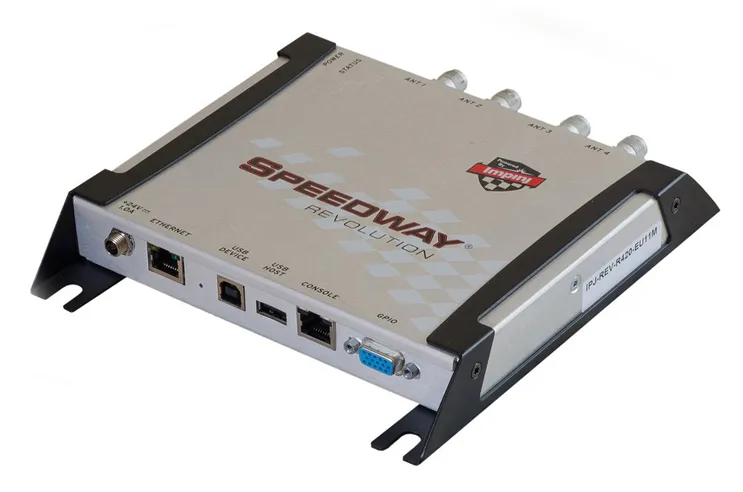
- A passive tag has no battery: it harvests energy from the reader's field and answers by changing how its antenna loads or reflects that field.
- LF and HF tags couple magnetically to the reader coil (inductive coupling, short range); UHF tags reflect the reader's radio wave back (backscatter, metres of range).
- In EPC Gen2, the reader runs an inventory round with Query, QueryRep, QueryAdjust and ACK commands to read tags one at a time, very fast.
- Anti-collision uses random time slots (the Q algorithm, a form of slotted ALOHA); the reader tunes the number of slots to the size of the tag population.
- Sessions and inventoried flags control whether a tag keeps answering or stays quiet, which matters for counting large populations.
The big picture
An RFID read is a short conversation. The reader speaks first and supplies all the energy; the tag only listens and responds. With a passive tag, the reader's radio signal does three jobs at the same time: it powers the tag, it carries commands to the tag, and it acts as the carrier that the tag modulates to send its answer back. Understanding that the tag "borrows" the reader's signal for everything is the key to understanding why RFID behaves the way it does, including why range is limited and why metal and water cause trouble.
The read cycle, step by step
Here is what happens in a typical passive UHF read using the EPC Gen2 (ISO/IEC 18000-63) protocol. LF and HF systems follow the same overall pattern with different details.
- The reader energises its antenna. It transmits a continuous wave (an unmodulated carrier) on a channel in the permitted band, for example within 865-867 MHz in India.
- The tag powers up. When a tag enters the field, its antenna captures a small amount of energy. A rectifier and charge pump on the chip convert it into a stable supply voltage. Once the voltage crosses the chip's threshold, the chip "wakes up". Modern UHF chips need only on the order of ten microwatts or less.
- The reader issues commands. It modulates the carrier to send commands: optionally a
Selectto pick which tags should take part (for example only tags whose EPC starts with a certain company prefix), then aQueryto start an inventory round. - Anti-collision sorts the tags out. Tags reply in random time slots so the reader can deal with them one at a time (explained below).
- The singled-out tag sends its identity. After the reader acknowledges it, the tag backscatters its Protocol Control (PC) bits, its EPC and a CRC checksum so the reader can detect errors.
- Optional memory access. If the application needs more than the EPC, the reader can ask the tag for a handle and then read or write other memory banks, such as the TID (chip serial number) or user memory, using a password if the memory is locked.
- The reader reports. For each read the reader records the EPC plus useful metadata: which antenna port saw it, the time, the received signal strength (RSSI) and often the phase. It sends these reports to the host, often over LLRP or a vendor API.
- Software turns reads into events. Middleware removes duplicates, applies rules and tells the business system something meaningful, such as "carton 123 passed dock door 4, outbound".
All of this happens in milliseconds. A good reader in a well-designed setup can inventory hundreds of tags per second.
In the real world
Two ways to talk: inductive coupling and backscatter
LF and HF: inductive (near-field) coupling
Low-frequency (125/134.2 kHz) and high-frequency (13.56 MHz) systems use coils. The reader's coil creates an alternating magnetic field. When a tag's coil sits in that field, a voltage is induced in it, exactly as in the secondary winding of a transformer. A tuning capacitor on the tag makes the coil resonate at the operating frequency so it collects as much energy as possible.
To reply, the tag uses load modulation: it switches a load across its coil on and off. Because the two coils are coupled, this slightly changes the current in the reader's coil, and the reader detects that change. HF standards commonly switch the load at a subcarrier frequency (for example about 847 kHz for ISO/IEC 14443 and about 424 kHz for ISO/IEC 15693) so the weak reply is easier to separate from the strong reader carrier.
The magnetic near field weakens very rapidly with distance, roughly with the cube of the distance, so inductive systems have short, well-defined ranges: typically a few centimetres for cards and up to around a metre for large HF vicinity antennas. That short range is actually an advantage for payments and access control, where you want only the card in front of the reader to respond.
UHF: far-field backscatter
At UHF (860-960 MHz) the wavelength is about 33-35 cm, and beyond a few centimetres from the antenna the reader's signal is a travelling radio wave. A UHF tag uses a dipole-like antenna tuned to that wavelength to capture energy from the wave.
To reply, the chip switches its antenna's impedance between two states. In one state the antenna absorbs most of the incoming energy; in the other it reflects more of it. This changes the strength (and phase) of the signal scattered back towards the reader, which the reader decodes. This is backscatter, the same idea described by Harry Stockman in 1948. Because the reader must keep transmitting the carrier while the tag replies, a UHF reader transmits and receives at the same moment, and separating the tiny reflected signal from its own powerful carrier is one of the hardest parts of reader design.
Anti-collision: reading many tags at once
If every tag in the field answered at the same moment, the replies would overlap and the reader would decode nothing. This is called a collision. RFID protocols solve it with anti-collision (also called singulation): a method of getting tags to take turns.
Slotted ALOHA in plain words
Imagine a teacher asking a class of 30 students to call out their roll numbers, but each student must first secretly pick a random number between 0 and 31 and speak only when the teacher counts to that number. Most counts will have zero or one student speaking. When exactly one speaks, the teacher writes the roll number down. When two speak together, the teacher cannot hear either, so those students try again in the next round. After a few rounds, everyone has been heard. That is slotted ALOHA, and Gen2's Q algorithm is a refined version of it.
The Gen2 Q algorithm
- The reader sends
Querycontaining a value Q between 0 and 15. Each participating tag picks a random slot number between 0 and (2 to the power Q) minus 1 and loads it into a counter. - Tags whose counter is 0 reply immediately with a 16-bit random number (RN16). The rest wait.
- If exactly one RN16 arrives cleanly, the reader sends
ACKwith that number. The tag recognises its own number and sends its PC, EPC and CRC. - The reader sends
QueryRepto move to the next slot. Every waiting tag decrements its counter, and any tag reaching 0 replies. - If a slot is empty, nothing is lost but a little time. If it has a collision, the reader skips it; those tags will get another chance.
- The reader watches the pattern. Many collisions mean Q is too small for the number of tags, so it raises Q with
QueryAdjust. Many empty slots mean Q is too big, so it lowers Q.
HF standards use their own anti-collision methods. ISO/IEC 14443 Type A, for instance, resolves collisions bit by bit on the card's unique ID, while ISO/IEC 15693 uses 16 time slots selected by bits of the tag ID. The goal is the same: let the reader address tags one at a time.
Sessions and inventoried flags
When a reader counts a large group of tags, it does not want the same strong tags answering again and again while weaker tags never get a turn. Gen2 handles this with inventoried flags. Every tag keeps a flag, with value A or B, in each of four sessions (S0, S1, S2 and S3). A Query names a session and a target (A or B); only tags whose flag in that session matches the target take part. After a tag is successfully read, it flips its flag (A to B), so it drops out of the following rounds and lets the others through.
The sessions differ in how long the flag "remembers" after the tag loses power or is left alone:
- S0: the flag resets to A as soon as the tag loses power, so in practice tags in S0 keep answering. Good for watching a single tag continuously.
- S1: the flag returns to A by itself after a short time (between about half a second and a few seconds), even if the tag is powered. Useful for tags that should be re-reported periodically.
- S2 and S3: the flag persists for at least a couple of seconds after power is lost, often longer. Ideal for counting large populations, because each tag answers once and then stays quiet even if the reader hops between antennas.
The Select command can also set a separate SL flag, so a reader can focus on a subset of tags such as one product family or one shipment. Two readers covering the same area are normally configured to use different sessions so they do not reset each other's flags.
What limits a read?
A passive read only succeeds if two links both work. The forward link must deliver enough power to wake the tag, and the reverse link must bring a strong enough reply back to the reader. With modern readers, which can hear very faint replies, passive UHF is usually limited by the forward link: the tag simply does not receive enough power to switch on. The main factors are:
- Transmit power and regulations: each country caps reader output. In India's 865-867 MHz band the limit is up to 4 W EIRP. More power means more range, up to the legal limit.
- Tag sensitivity: chips and antenna designs differ; a more sensitive tag reads further.
- Orientation and polarisation: a simple dipole tag barely responds when it points straight at the antenna along its own axis. Circularly polarised reader antennas tolerate random tag orientation at the cost of some range; linearly polarised antennas reach further when tags are aligned.
- Materials: metal reflects and detunes; water and other liquids absorb UHF energy. Tags made for these surfaces, or spacing the tag away from them, restore performance.
- Distance and the environment: signal strength falls with distance, and reflections from walls, racks and floors create dead spots (nulls) and unexpected long-range reads.
- Cable and connector losses: long or thin coaxial cables waste reader power before it reaches the antenna.
- Interference and other readers: nearby readers and other radio sources can overwhelm the faint tag reply; dense-reader modes and channel planning help.
- Speed and dwell time: a tag moving quickly past an antenna must be powered and read in a short window, especially when many tags pass together.
All of these are explored in depth in RFID Read Range and Performance, and choosing between LF, HF and UHF is covered in RFID Frequencies.
Putting it into practice
For a working engineer, the theory translates into a few habits. Choose the frequency and tag to suit the item and its surroundings. Place reader antennas so the tag's best direction faces them as items move past. Configure session, target and RF mode for the job: S0 or S1 for single-tag or repeated monitoring, S2 or S3 for counting. Keep cables short. Then test with real items in the real location, because reflections and materials make every site a little different.
Whether you use fixed readers at a doorway or handheld readers for cycle counts, the same read cycle is running underneath. Next, see how all the hardware and software pieces fit together in Components of an RFID System.
Watch & learn
Videos are from YouTube and their respective creators; they play only when you click.
Help India adopt this fast-growing technology - teach, consult or build projects with Indian RFID.
Frequently asked questions
How does a passive RFID tag work without a battery?
The tag antenna captures part of the energy in the reader's signal, and a rectifier on the chip converts it into a small DC voltage that runs the chip. It then replies by modulating the reader's own signal rather than transmitting its own.
What is backscatter in RFID?
Backscatter is how passive UHF tags reply. The chip switches its antenna between two impedance states, which changes how much of the reader's radio wave is reflected back. The reader detects this pattern of stronger and weaker reflection as data.
How does an RFID reader read many tags at once?
It does not read them at exactly the same instant. It uses an anti-collision protocol in which each tag picks a random time slot to reply, so the reader can single out and read tags one by one, often hundreds per second.
What is the Q value in RFID?
Q is a number sent in the Gen2 Query command that sets the number of reply slots to 2 to the power Q. A higher Q suits large tag populations; the reader adjusts it during an inventory based on how many collisions and empty slots it sees.
Why does my RFID tag not read near metal or water?
Metal detunes and shields a standard tag antenna, and water absorbs UHF energy. The tag then cannot collect enough power to wake up. On-metal tags, spacers or different tag placement usually solve the problem.
Join the 1-month Certified RFID Specialist Program - live online. New batch 12 January 2027.