Every bag and packet of seed sold in India must carry a correct label - and certified seed must also carry the official coloured certification tag. A wrong colour, a missing lot number, a faded test date or an expired validity can stop a lot from being sold. This guide explains the rules, the colours and sizes, the new QR traceability, and how seed companies print tags and labels reliably.
1. The law: Seeds Act, Seeds Rules and Seeds (Control) Order
Seed labelling in India is governed by the Seeds Act, 1966 and the Seeds Rules, 1968. Section 6(b) of the Act lets the Government notify the particulars that seed of notified kinds and varieties must carry, and Section 7 makes it an offence to sell such seed unless the container is marked or labelled with them. Part V of the Seeds Rules (Rules 7 to 13) sets out the labelling details:
- Rule 7 - the person whose name is on the label is responsible for its accuracy while the container is unopened (but not for germination after the validity date).
- Rule 8 - the contents of the label (see the next section).
- Rule 9 - the label goes on the innermost container and on every covering; it may instead be marked indelibly on the container.
- Rules 10-12 - no false or misleading statements and no disclaimers on the label.
- Rule 13 - seed may not be sold after the validity date, labels must not be defaced, and records must be kept for three years.
- Rule 17 and Form II - the certification tag and seal used by certification agencies.
The Seeds (Control) Amendment Order, 2006 (clause 8A) extends this: every dealer, including dealers in non-notified seed, must meet the Section 6 standards and any further standards for the size, colour and content of the label. A new Seeds Bill proposing QR codes on every packet and a central traceability portal has been under consultation, so watch for updates.
2. What must be printed on a seed label
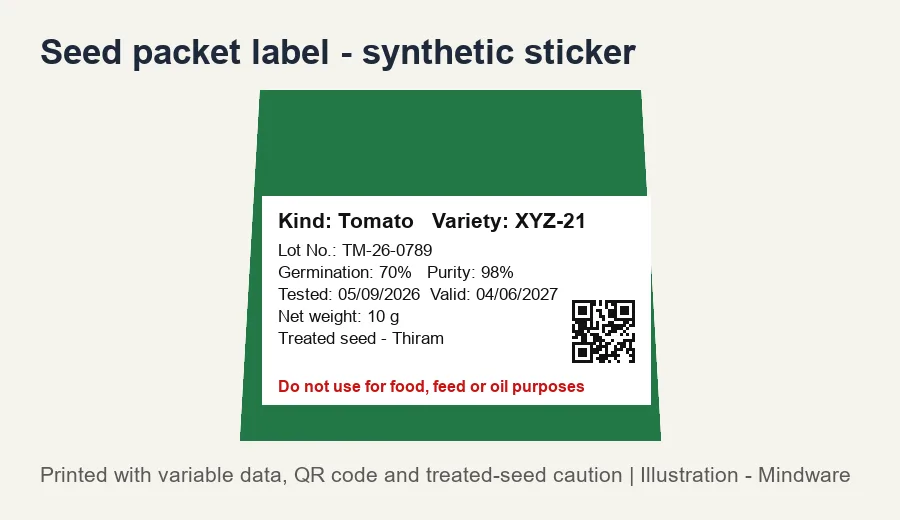
Under Rule 8 of the Seeds Rules, the label must carry the particulars notified under Section 6(b) of the Act and the following details. In practice a seed label or tag shows:
| Item | What to print |
|---|---|
| Kind and variety | Crop / kind and the variety name as notified |
| Lot number | The seed lot identification |
| Germination | Percentage, not below the notified minimum |
| Physical purity | Percentage of pure seed |
| Genetic purity | Where notified for the crop |
| Date of test and validity | Date of testing; valid-up-to date |
| Net quantity | Net weight in metric units |
| Name and address | Of the person responsible for the label / seller |
| Treated seed (if treated) | Statement that the seed is treated, the generic chemical name and the caution "Do not use for food, feed or oil purposes" (with "Poison" in red for mercurial and similarly toxic treatments) |
The detailed list of notified particulars comes from Section 6(b) notifications and state guidance - always confirm the current list for your crop with your State Seed Certification Agency or seed inspector.
3. Seed tag colours by class
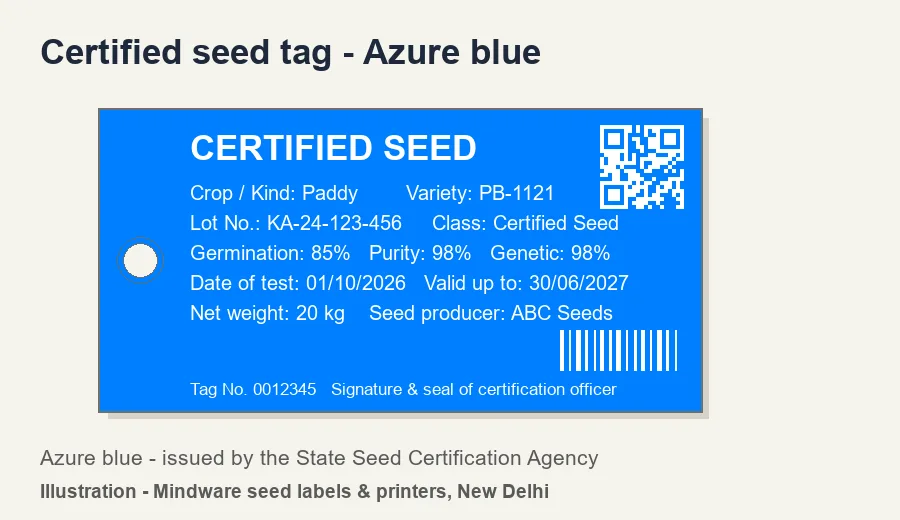
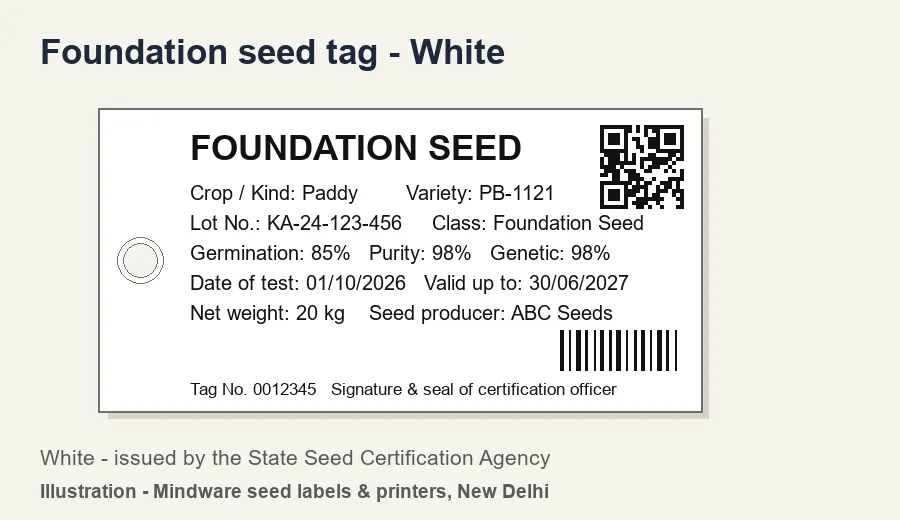
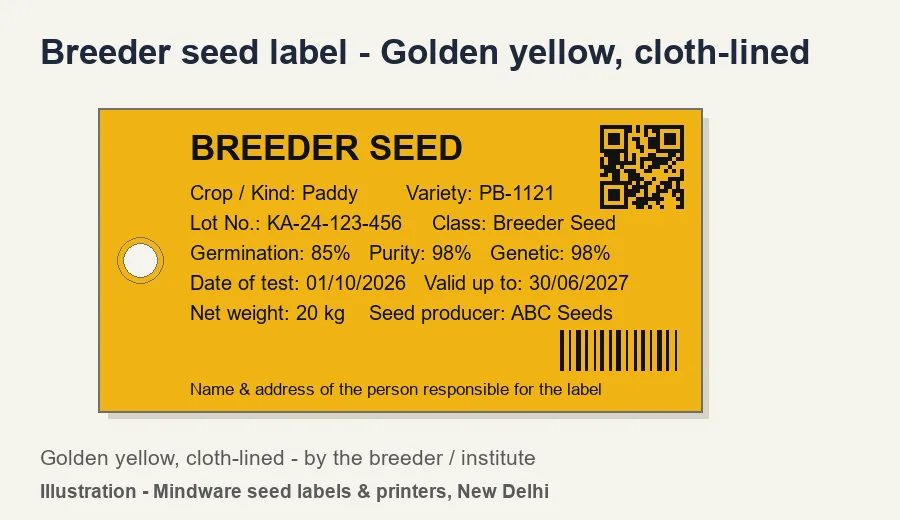
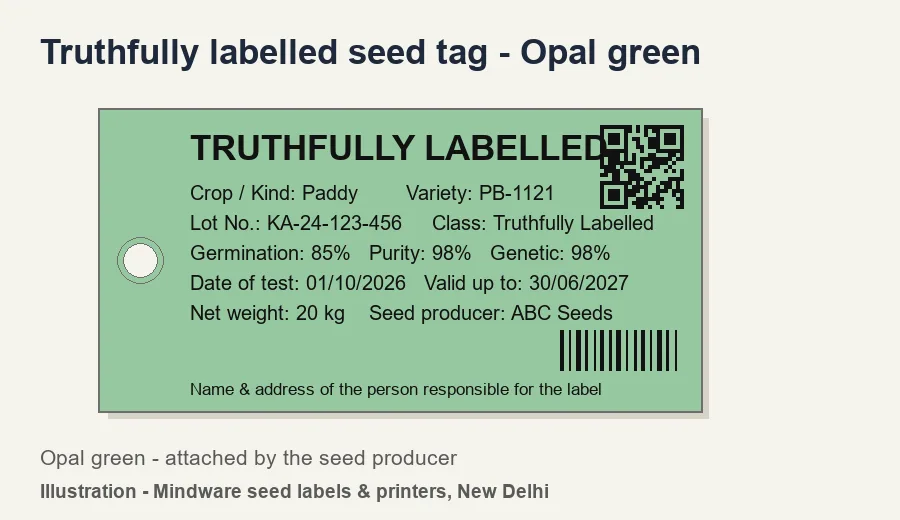
| Seed class | Tag / label colour | Issued / attached by |
|---|---|---|
| Breeder seed | Golden yellow label (cloth-lined, 12 x 6 cm) | The breeder / institute producing breeder seed |
| Foundation seed | White tag (both sides) | State Seed Certification Agency |
| Certified seed | Azure blue tag (both sides) | State Seed Certification Agency |
| Truthfully labelled (TL) seed | Opal green tag | The seed producer (no certification agency) |
Colours as given in the Indian Minimum Seed Certification Standards and ICAR guidance. Older Seeds Rules text also mentions a purple tag for "registered" seed, a class not used in the current standards.
Seed tags by state - sample designs
Seed tag layout, wording, numbering and QR details differ from state to state and company to company. Below are sample designs for major seed-producing states, each with the label quality (tag material and print) we recommend - Mindware prints seed tags and labels to the exact format you specify.
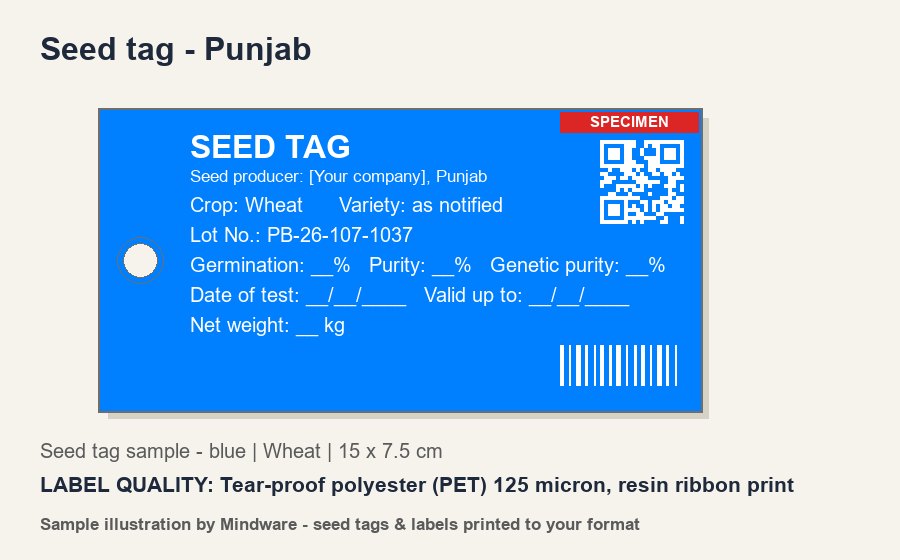
Label quality: Tear-proof polyester (PET) 125 micron, resin ribbon print
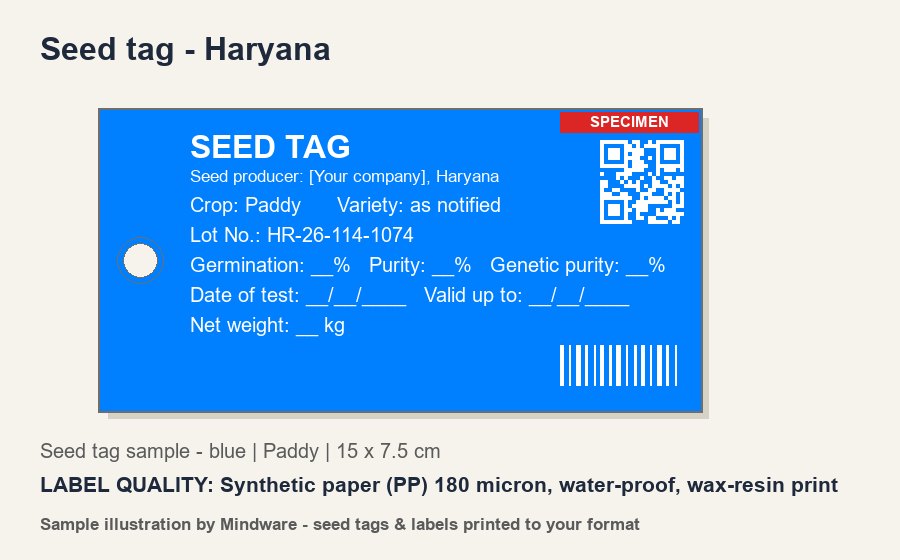
Label quality: Synthetic paper (PP) 180 micron, water-proof, wax-resin print
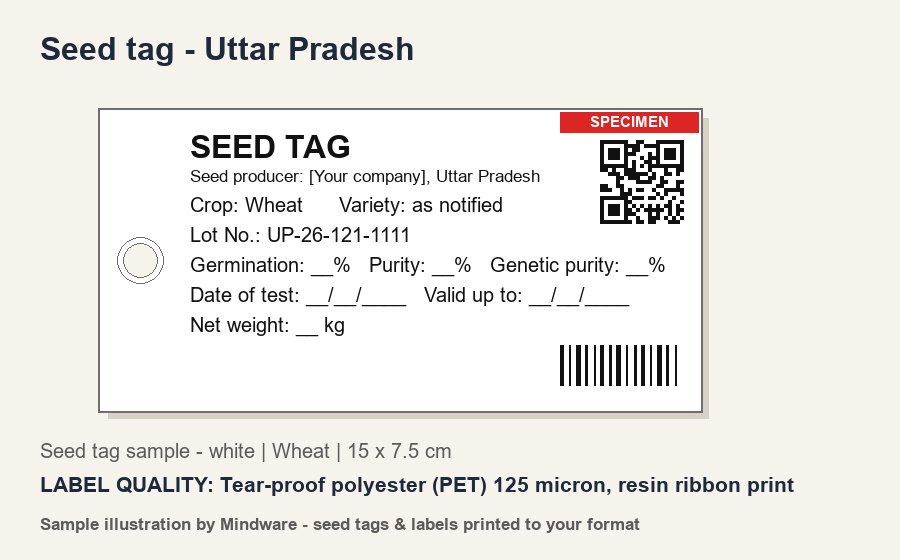
Label quality: Tear-proof polyester (PET) 125 micron, resin ribbon print
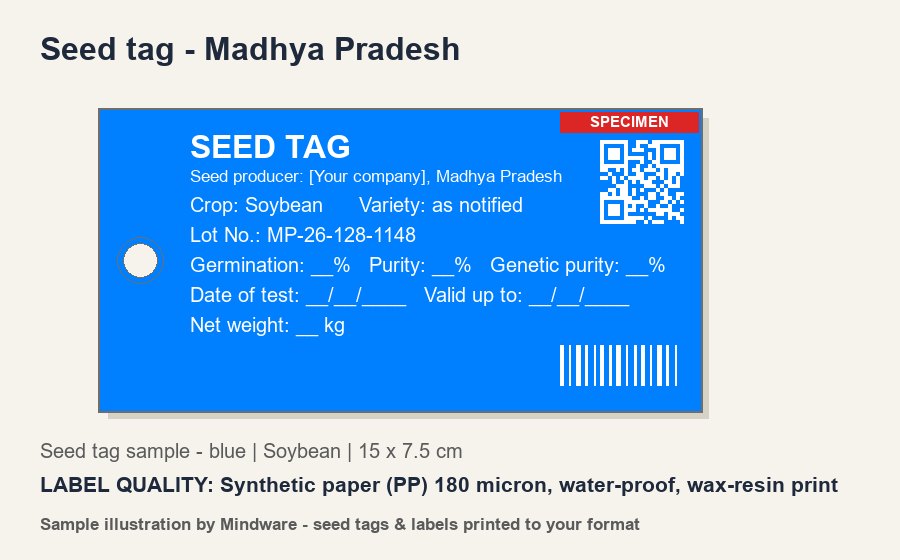
Label quality: Synthetic paper (PP) 180 micron, water-proof, wax-resin print
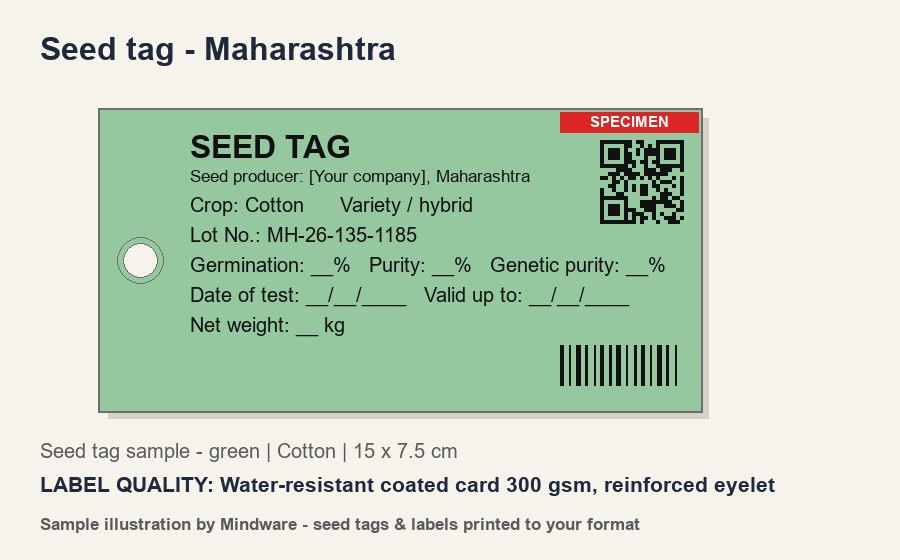
Label quality: Water-resistant coated card 300 gsm, reinforced eyelet
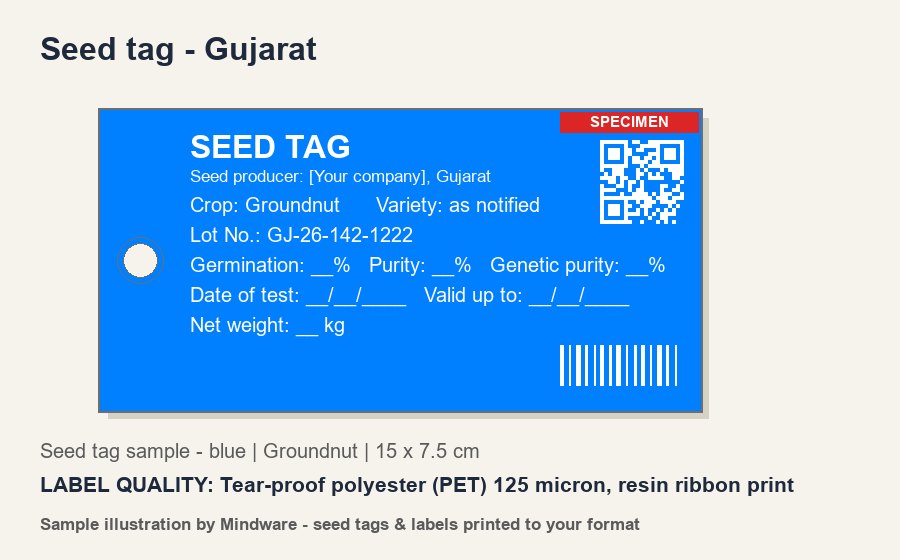
Label quality: Tear-proof polyester (PET) 125 micron, resin ribbon print
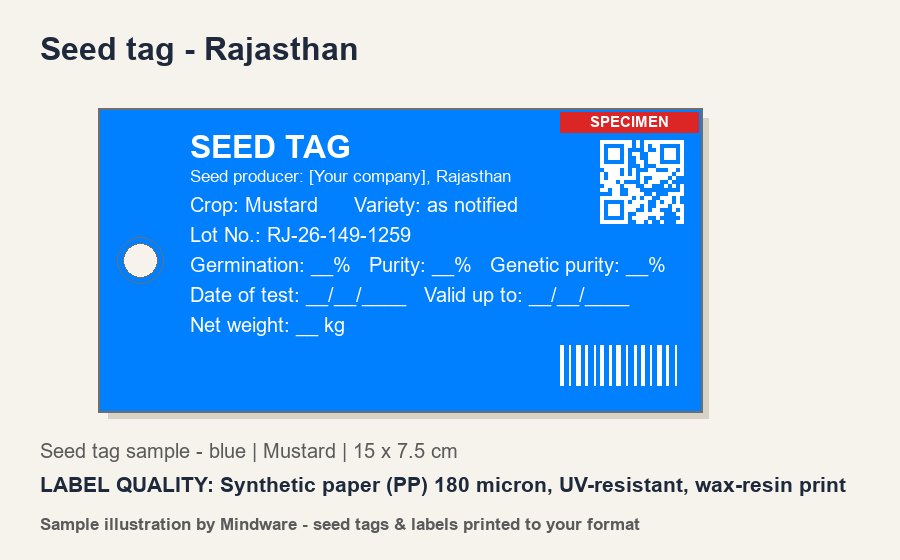
Label quality: Synthetic paper (PP) 180 micron, UV-resistant, wax-resin print
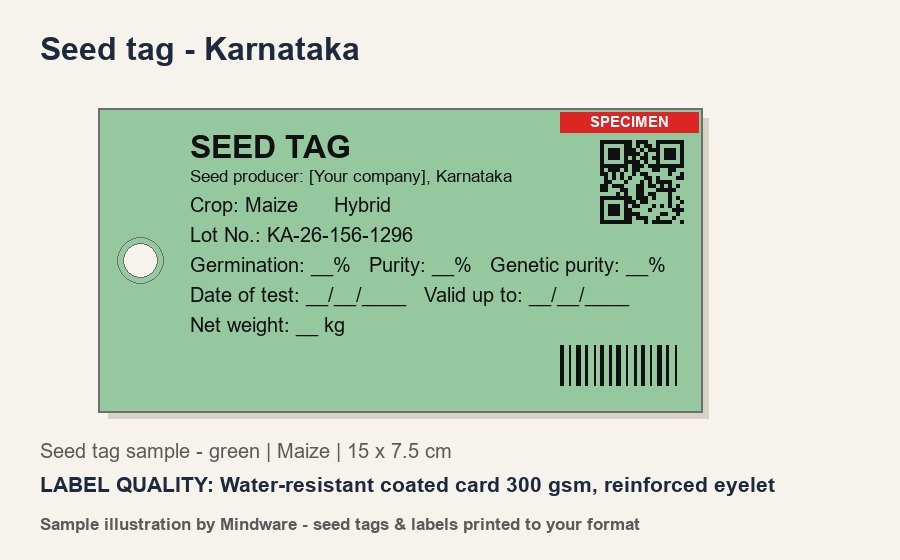
Label quality: Water-resistant coated card 300 gsm, reinforced eyelet
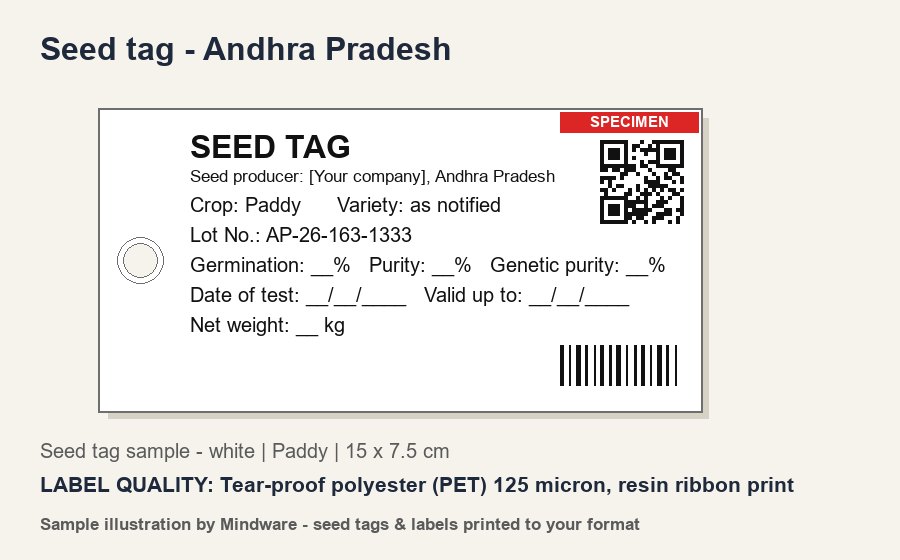
Label quality: Tear-proof polyester (PET) 125 micron, resin ribbon print
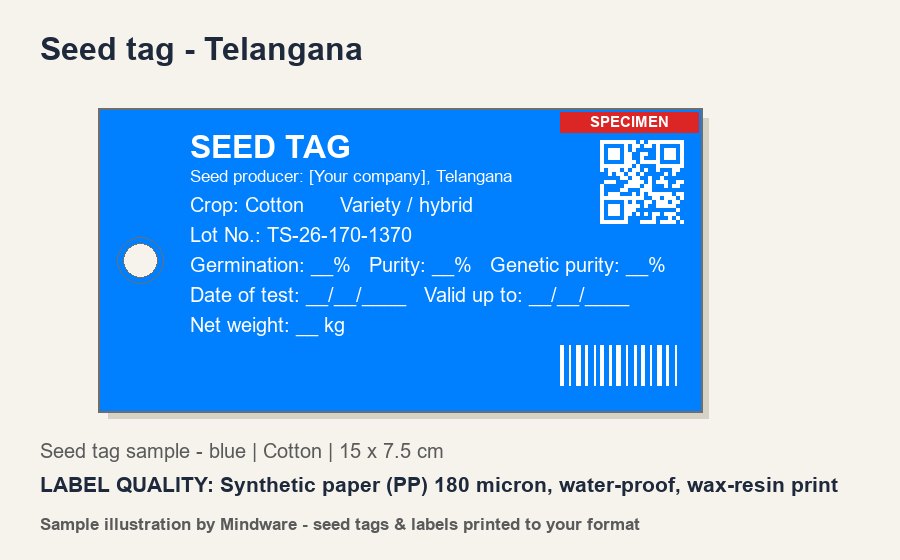
Label quality: Synthetic paper (PP) 180 micron, water-proof, wax-resin print
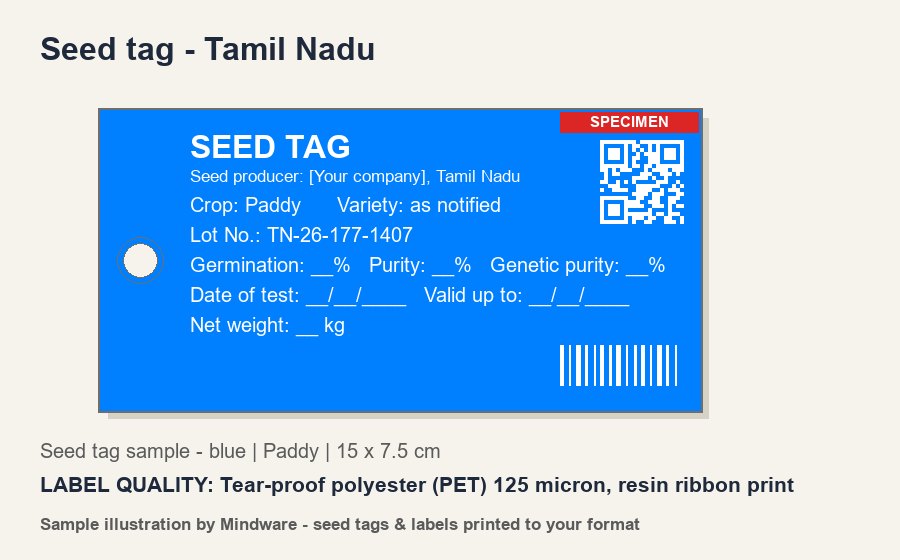
Label quality: Tear-proof polyester (PET) 125 micron, resin ribbon print
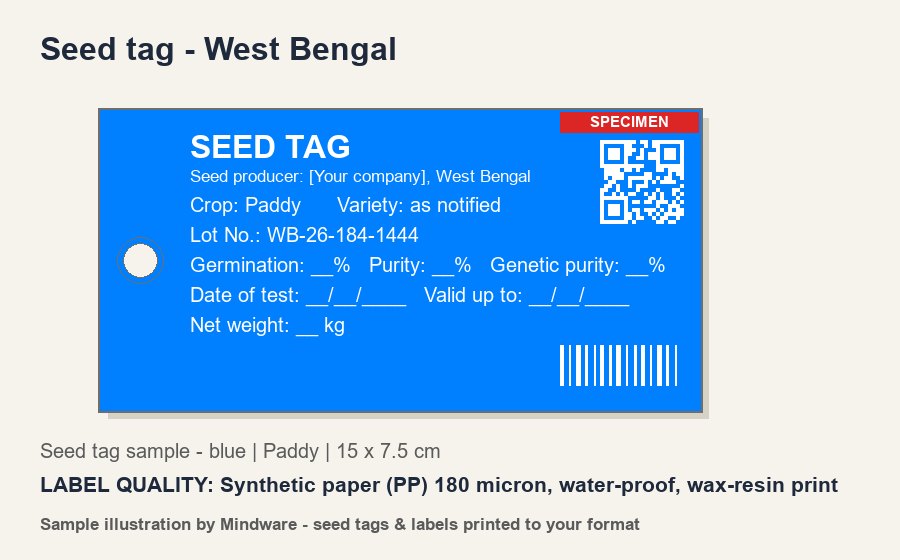
Label quality: Synthetic paper (PP) 180 micron, water-proof, wax-resin print
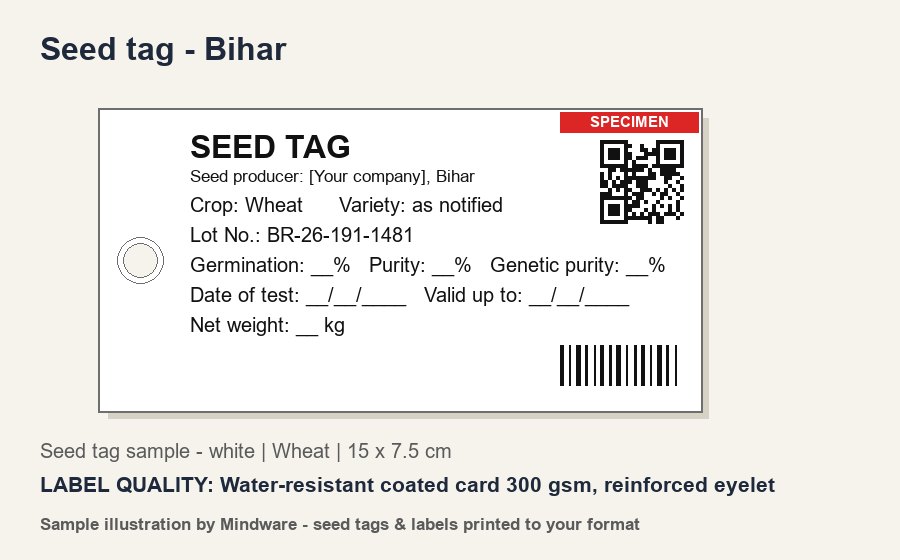
Label quality: Water-resistant coated card 300 gsm, reinforced eyelet
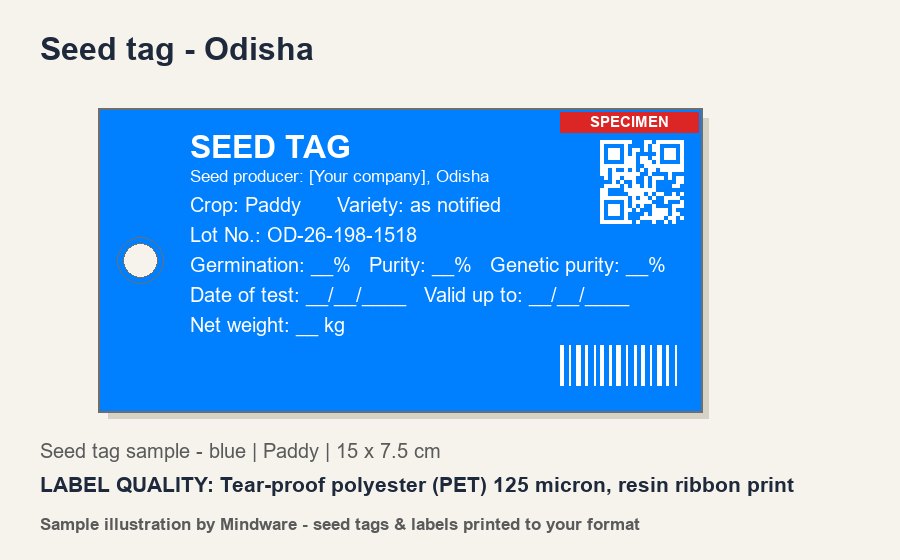
Label quality: Tear-proof polyester (PET) 125 micron, resin ribbon print
Note: these are our own sample illustrations marked SPECIMEN, shown without any seal or certification mark. Send us your tag format and we will match it - in tear-proof polyester, water-proof synthetic paper or coated card, with resin or wax-resin ribbon for smudge-free printing.
4. Size, material and attaching tags
- Certification tag size: 15 cm x 7.5 cm, which may be reduced in proportion for small containers (Indian Minimum Seed Certification Standards 2013, Appendix X).
- Breeder seed label: 12 cm x 6 cm, cloth-lined.
- Material: the standards allow thick paper, paper with cloth lining, wax-coated or plastic-coated paper. Many companies now use tear-proof synthetic (PP / PET) tag stock that survives handling, moisture and long storage.
- Attaching: tags are stitched or sealed to the bag; certification tags carry the signature and stamp of the certification official on the back.
- Small packets: vegetable and flower seed packets usually carry a printed self-adhesive label or are printed directly with the required particulars.
5. Validity and re-validation tagging
Certified seed is valid for 9 months from the date of test, and can be extended by 6 months at a time after each successful re-test. On re-validation the new date and the agency are stamped on the existing tags; if a lot is re-bagged, new tags are issued that copy the original details. Seed must not be sold after the validity date (Rule 13), so validity printing must be clear and durable.
6. SATHI, QR codes and traceability
SATHI - Seed Authentication, Traceability & Holistic Inventory - is the Government of India seed traceability portal (seedtrace.gov.in), launched in April 2023. Phase I covers the seed chain from nucleus and breeder seed to foundation and certified seed, including certificates and tagging. Phase II extends it to dealer licensing and the supply chain, with QR-coded seed bags tracked from producer to dealer to farmer.
Several states and crops (for example Bt cotton packets) have also introduced QR requirements. The exact QR content and format come from the portal and your state agency, so check the current instructions before designing tags - and choose tag stock and printers that print sharp, scannable QR codes.
7. Seed tags and labels we make
- Plain (blank) seed labels and tags - in all four colours, ready to print on your own thermal transfer printer.
- Seed certification and TL tags in white, azure blue, golden yellow and opal green - 15 x 7.5 cm and custom sizes, with eyelet / hole for stitching.
- Tear-proof synthetic tag stock (PP / PET) and coated paper options, pre-printed with your fixed design.
- Seed packet labels - self-adhesive labels for pouches, tins and boxes, with the treated-seed caution in red where needed.
- Variable-data printing - lot number, test date, validity, germination, purity, serial numbers, barcodes and QR codes.
- Rolls or fan-fold to run on desktop and industrial barcode printers; stock dies from our die list, new sizes on request.
8. Printers, ribbons and scanners
Seed companies usually keep pre-printed coloured tags in stock and print the variable data in-house, lot by lot. For this we supply:
- Thermal transfer barcode printers - 4-inch desktop and industrial models from TSC, Zebra, GoDEX and others (paid service and AMC available).
- Resin ribbons (Mynds) for smudge-proof, water-resistant print on synthetic tags.
- Label software to print lot data and QR codes from Excel or your ERP.
- 2D barcode scanners and mobile computers to scan QR codes at the warehouse and dealer.
See also: types of barcode labels · types of barcode scanners · warehouse solutions
Frequently asked questions
What colour is a certified seed tag in India?
Under the Indian Minimum Seed Certification Standards, the certified seed tag is azure blue on both sides and the foundation seed tag is white on both sides; both are issued by the State Seed Certification Agency. Breeder seed carries a golden yellow label, and truthfully labelled seed carries an opal green tag attached by the producer.
What is the size of a seed certification tag?
The Indian Minimum Seed Certification Standards (2013, Appendix X) prescribe 15 cm x 7.5 cm, reducible in proportion for small containers. The breeder seed label is 12 cm x 6 cm and cloth-lined.
What must be printed on a seed label?
Under Rule 8 of the Seeds Rules 1968: the particulars notified under Section 6(b) of the Seeds Act (such as kind, variety, lot number, germination and purity), net weight in metric units, date of testing, the seller's name and address, and - for treated seed - a treated-seed statement, the chemical name and the caution "Do not use for food, feed or oil purposes".
What is SATHI in seed labelling?
SATHI (Seed Authentication, Traceability & Holistic Inventory) is the Government of India portal at seedtrace.gov.in, launched in April 2023. It tracks seed from breeder to certified seed and, in its second phase, uses QR-coded seed bags traced from producer to dealer to farmer.
Can we print seed tags on our own barcode printer?
Yes. Most seed companies print variable data (lot, test date, validity, QR / barcode) on pre-printed coloured tag stock using thermal transfer barcode printers with resin ribbons. Mindware supplies the tag stock, printers, ribbons and set-up.
Disclaimer: this guide summarises the Seeds Act 1966, Seeds Rules 1968, the Seeds (Control) Order and the Indian Minimum Seed Certification Standards for general information. Rules and state instructions change - always confirm current requirements with your State Seed Certification Agency, seed inspector or the SATHI portal before printing.