Components of an RFID System
A working RFID system is much more than a tag and a reader. This chapter explains every component, from tags, readers and antennas to cables, printers, middleware, business software, network, power and mounting, and shows how they fit together. It ends with a checklist you can use to plan a project.
- The core trio is tag, reader and antenna, but cables, printers, middleware, host software, network, power and mounting all affect whether a system works.
- Readers come as fixed, handheld, integrated, desktop, embedded modules and printers; choose by where and how items move.
- Antennas shape the read zone; cable length and quality decide how much reader power actually reaches them.
- Middleware turns thousands of raw reads into a few meaningful business events and connects RFID to WMS, ERP or other systems.
- Plan network, PoE power, mounting and tag encoding early; these are where many projects slip.
An RFID system at a glance
In the first chapter we met the core trio of RFID: tag, reader and antenna. That is enough to explain the idea, but a system that runs reliably in a warehouse, factory, hospital or shop needs more. A typical deployment has three layers:
- The physical layer: tags on the items, reader antennas where items pass or sit, cables and connectors, mounting hardware and the printers or encoders that prepare tags.
- The edge layer: readers, together with their network connection, power supply and any lights, sensors or alarms wired to them.
- The software layer: middleware that manages readers and cleans up data, and the business applications (WMS, ERP, asset register, access control) that act on it.
Weakness in any layer shows up as a "bad RFID system", even if the tags and readers themselves are excellent. Let us look at each component.
Tags
The tag (or transponder) is attached to every item you want to identify. It contains a chip, which stores the ID and handles the radio protocol, connected to an antenna. The chip and antenna on a thin film are called an inlay; the inlay is then converted into a finished tag such as a paper label, a plastic card, a wristband or a rugged hard tag.
For a project, the tag decisions are:
- Frequency: LF, HF/NFC or UHF, set by required range, the materials involved and any existing standard you must follow.
- Power type: passive in the vast majority of cases; active or battery-assisted only where long range or sensing justifies the cost.
- Chip and memory: EPC size, user memory, passwords and special features.
- Form factor and mounting: label, hard tag, on-metal tag, embedded tag and so on, chosen to survive the item's life.
Tags are covered in detail in Types of RFID Tags.
In the real world
Readers
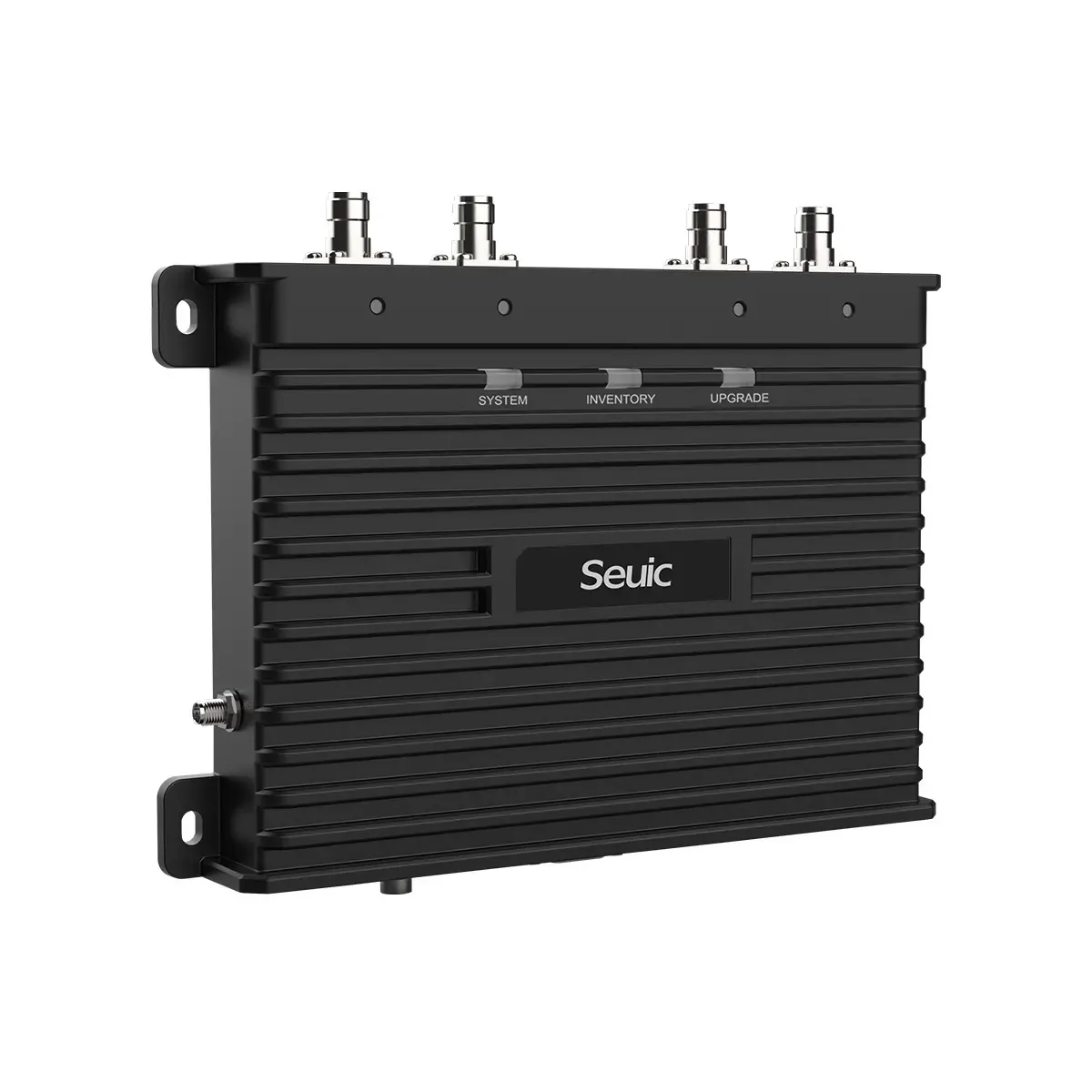
The reader (or interrogator) generates the radio signal, runs the protocol that inventories tags, and reports results. Readers vary mainly by form:
- Fixed readers: mounted at dock doors, gates, conveyors, shelves or production lines. They typically have 1, 2, 4 or 8 external antenna ports (more with multiplexers), Ethernet, and general-purpose inputs and outputs (GPIO).
- Integrated readers: a reader and antenna in one housing, simpler to install where one read zone is enough.
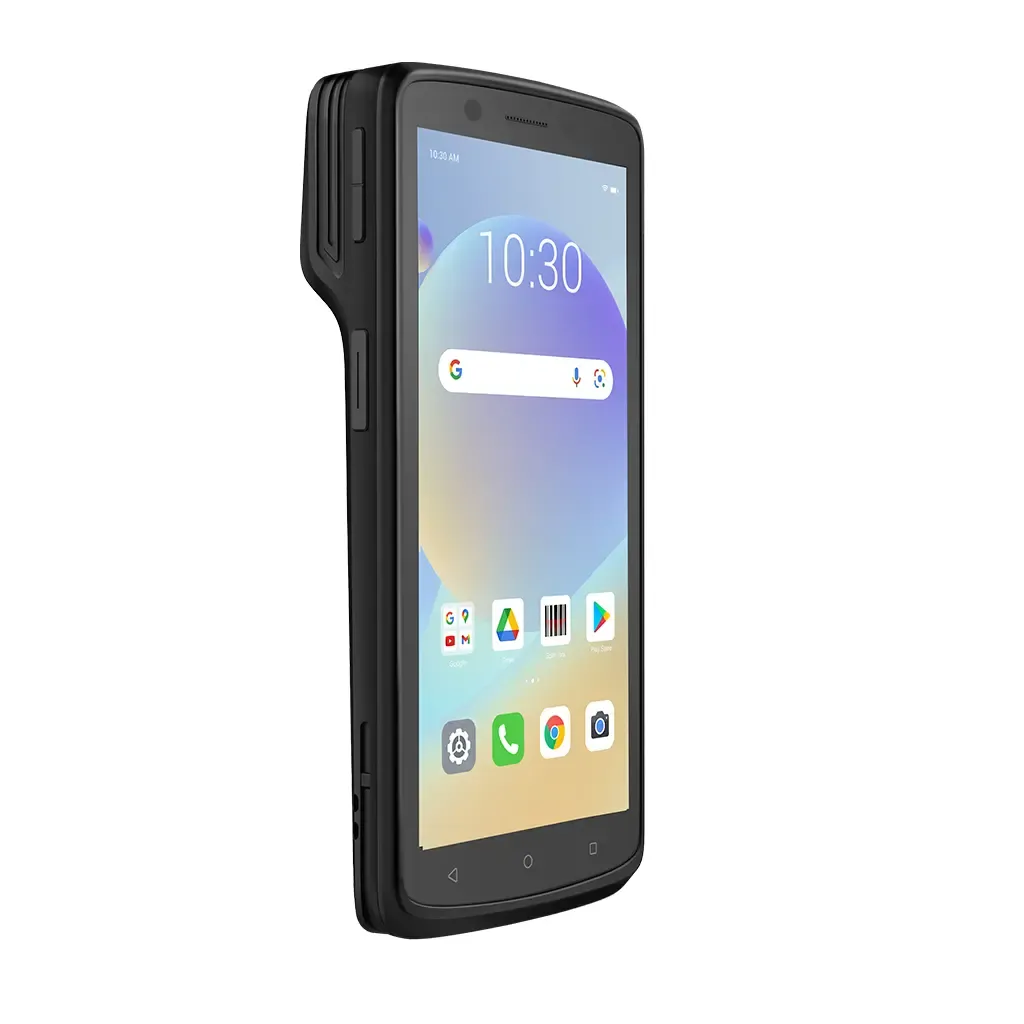
- Handheld readers: mobile computers or sleds for cycle counts, searches and receiving. Many attach to or include an Android device and also scan barcodes.
- Desktop readers: short-range USB units for point-of-sale, library counters or encoding stations.
- Embedded modules: reader boards built into other equipment such as kiosks, smart cabinets, vehicles or machines.
- Printer-encoders: a reader inside a label printer (see below).
Key specifications include supported frequency band and regions (a UHF reader for India must operate in 865-867 MHz), maximum output power, receive sensitivity, number of antenna ports, supported protocols, interfaces (Ethernet, USB, serial, Wi-Fi, Bluetooth), power options and environmental rating. Browse fixed RFID readers for examples; reader types are compared in depth in RFID Readers Explained.
Antennas
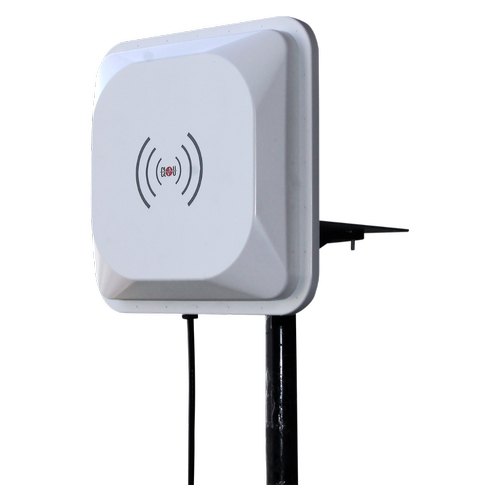
The reader antenna turns the reader's electrical signal into a radio field and collects the tags' replies. It, more than the reader, decides the shape and size of the read zone. Important properties:
- Gain: how strongly the antenna concentrates energy in one direction. Higher gain means a longer but narrower beam.
- Beamwidth: the angle over which the antenna radiates effectively. Wide beams cover a doorway; narrow beams target one lane or shelf.
- Polarisation: circular antennas read tags in any rotation around the beam axis; linear antennas reach further when tag orientation is controlled.
- Near-field vs far-field: near-field UHF antennas create a deliberately short, tight zone, for example on a conveyor or a jewellery tray, to avoid reading neighbouring items.
- Form: panel antennas for walls and portals, low-profile shelf and mat antennas, ruggedised outdoor antennas, and coil antennas for LF and HF.
Antennas must match the reader's frequency band. Using a 902-928 MHz antenna on an Indian 865-867 MHz system wastes power and can damage performance. See RFID antennas for options.
Cables and connectors
Fixed readers connect to external antennas with coaxial cable, usually 50-ohm. Every metre of cable loses some signal, and the loss counts twice: once on the way out (less power reaches the tag) and again on the way back (a weaker reply reaches the reader). As a rule of thumb at UHF, thin, flexible cables lose noticeably more per metre than thick, low-loss types, so thicker cable is preferred for runs beyond a few metres even though it is stiffer and harder to route.
Common RF connectors on RFID equipment include reverse-polarity TNC (RP-TNC), SMA and N-type. Check both ends, use proper adaptors only when unavoidable (each one adds a little loss), tighten connectors properly and protect outdoor joints from water. A loose or damaged connector is one of the most common causes of a read zone that "suddenly stopped working".
Printers and encoders
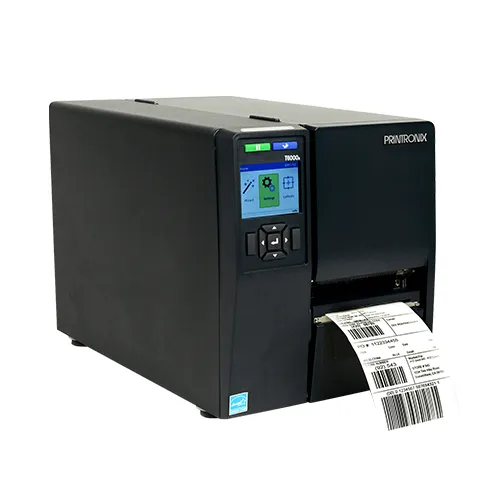
Before a tag is useful, its memory usually needs to be encoded with the right data, typically an EPC based on your GS1 company prefix or an internal numbering scheme, and the label often needs human-readable text and a barcode as well. Options are:
- RFID printer-encoders: thermal-transfer or direct-thermal label printers with a built-in reader. They encode the inlay, verify it, print the label and mark or reject faulty tags, all in one pass. See RFID printers.
- Desktop or handheld encoders: for hard tags, cards or small batches that cannot go through a printer.
- Pre-encoded supply: tag converters can deliver labels already encoded and printed to your specification, useful for high volumes.
- Inline encoding: in manufacturing, a reader at a station encodes tags as products move along the line.
Printing and encoding workflows are covered later in the course, in the Implementation module.
Middleware and host software
Middleware
A reader can report the same tag dozens of times per second, from several antennas. Business systems do not want that flood. Middleware sits in between and typically:
- configures, monitors and updates readers centrally;
- filters and smooths raw reads (removing duplicates, ignoring stray reads, applying time windows);
- adds context: which door, which direction, which process step;
- decodes EPCs into product numbers and serials;
- drives devices such as stack lights, buzzers and barriers through reader GPIO;
- sends clean events to business applications through APIs, message queues or files.
Standards help here: LLRP (Low Level Reader Protocol) is a common standard interface for controlling UHF readers, and GS1's EPCIS standard defines how to record and share "what, when, where and why" events about tagged items. Middleware can run on a server, in the cloud or on the reader itself, since many modern readers can host applications at the edge. More in RFID Middleware and Software.
Host software and ERP
The real value appears when RFID events update the systems people use: a warehouse management system (WMS), ERP, retail inventory system, asset register, library management system, hospital system or access-control database. Integration questions to answer early: who owns the master data that links each EPC to a product or asset, which events should create transactions, and what happens when a read is missing.
Network, power and mounting
Network
Fixed readers usually connect by wired Ethernet for reliability; handhelds use Wi-Fi or mobile data. Plan IP addressing, VLANs, firewall rules for reader management and data ports, time synchronisation (so read timestamps are accurate) and network security. Readers are network devices and should be managed like any other: change default passwords and keep firmware updated.
Power and PoE
Many fixed readers can be powered over Ethernet (PoE), which saves running separate mains power to a ceiling or door frame. Check whether the reader needs standard PoE (IEEE 802.3af) or higher-power PoE+ (IEEE 802.3at). Some readers run at reduced RF output or with fewer active antennas on lower PoE classes. Make sure your switch has enough total PoE budget for all readers, and consider a UPS for critical read points.
Mounting and enclosures
Antennas need brackets that hold them at the right height and angle and keep them there when forklifts pass. Portals, gate frames, shelf fixtures and conveyor tunnels are common structures, and RF-shielded or absorbent panels can stop read zones bleeding into neighbouring areas. Outdoors or in washdown areas, choose suitably rated enclosures. Ready-made gate and portal assemblies can save design time.
How the components fit together
Follow one tagged carton through a system and every component plays a part. At the packing station a printer-encoder writes the carton's EPC and prints its label. The carton moves to the dock door, where antennas mounted on a portal frame create a read zone. The fixed reader, powered over Ethernet, inventories the tags, reads the carton's EPC several times, and reports each read with antenna number, time and RSSI. Middleware collapses those reads into one event, works out from antenna sequence that the carton is moving outward, and sends "carton shipped on order X" to the WMS, which updates stock and triggers the invoice. If something is missing, the stack light turns red and the operator checks before the truck leaves.
Component checklist for your project
| Component | Key questions | Common pitfalls |
|---|---|---|
| Tags | Which frequency and chip? What surface and environment? How will they be attached and encoded? | Choosing on price alone; not testing on the real item |
| Readers | Fixed, handheld or both? How many read points? Correct regional band? | Buying a reader for the wrong region or too few antenna ports |
| Antennas | What zone size and shape? Circular or linear? Near-field needed? | Oversized zones that read neighbouring areas |
| Cables and connectors | Shortest practical length? Matching connector types? | Long thin cables, loose or mismatched connectors |
| Printers and encoders | Who encodes, where and with which numbering scheme? | No plan for duplicate or failed encodes |
| Middleware | Which filtering and business rules? Central reader management? | Sending raw reads straight to the ERP |
| Host software | Which system owns the data? Which events create transactions? | Integration left until after hardware is installed |
| Network | Wired or wireless? IP plan, security, time sync? | Readers on default passwords or unmanaged networks |
| Power | Mains, PoE or PoE+? Total switch budget? UPS? | Reader underpowered on standard PoE |
| Mounting | Height, angle, protection from impact? Shielding needed? | Antennas knocked out of position by traffic |
If you would like help selecting and integrating components, the Indian RFID consulting team can assess your site and process. Next, Module 2 begins with RFID Frequencies: LF, HF, UHF and Microwave.
Watch & learn
Videos are from YouTube and their respective creators; they play only when you click.
Help India adopt this fast-growing technology - teach, consult or build projects with Indian RFID.
Frequently asked questions
What are the three main components of an RFID system?
The tag, the reader and the reader antenna. In practice you also need software to make use of the data, plus cables, power, network and mounting hardware.
What does RFID middleware do?
Middleware sits between readers and business systems. It manages and monitors readers, filters duplicate reads, adds context such as location and direction, and sends clean events to WMS, ERP or other applications.
Can an RFID reader run on PoE?
Many fixed UHF readers can be powered over Ethernet. Some run on standard PoE, while others need PoE+ to deliver full transmit power to several antennas, so check the reader specification before choosing switches or injectors.
How long can an RFID antenna cable be?
There is no fixed limit, but every metre of coaxial cable loses some power. Keep cables as short as practical and use thicker, lower-loss cable for longer runs.
Do I need an RFID printer?
If you will tag items yourself on demand, an RFID printer that prints and encodes labels in one step is the simplest option. If tags arrive pre-encoded from a supplier, or you use rugged hard tags, a desktop or handheld encoder may be enough.
Join the 1-month Certified RFID Specialist Program - live online. New batch 12 January 2027.