RFID Readers Explained
The reader is the active heart of an RFID system: it powers passive tags, talks to them and passes their data to software. This chapter explains the main reader types, the specifications that really matter, how readers connect to networks and software, and how to choose the right reader for a job.
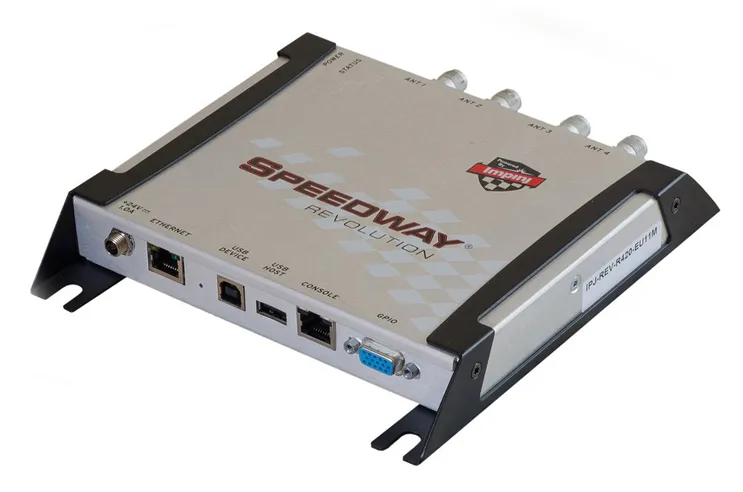
- Reader types range from multi-port fixed readers and integrated readers to handhelds, Bluetooth sleds, desktop encoders and embedded modules.
- Key specifications are frequency/region, output power, receive sensitivity, number of antenna ports, interfaces and supported protocols.
- In India, UHF readers must be configured for the 865-867 MHz band.
- LLRP is the standard reader control protocol for UHF; vendor SDKs, MQTT and HTTP/REST are common alternatives for integration.
- Choose readers by use case - where reads happen, how many tags, how fast, and how data reaches your software.
What an RFID reader does
An RFID reader (also called an interrogator) is a radio transceiver with a small embedded computer. In a passive system it does four jobs at once:
- Transmits energy through its antenna to power passive tags.
- Sends commands - for UHF EPC Gen2 these include Select, Query, Read, Write and Lock - by modulating that signal.
- Receives and decodes the very weak replies from tags, while still transmitting its own much stronger carrier.
- Filters and forwards data to software over a network, serial or wireless link, often adding timestamp, antenna port, signal strength (RSSI) and phase.
The physics behind this exchange is explained in How RFID Works. This chapter focuses on choosing and using readers. Most examples concern UHF readers, since that is where reader choice is most complex, but the same categories exist for HF and LF.
Types of RFID readers
Fixed readers with antenna ports
A fixed reader is a box mounted on a wall, ceiling or rack, connected by coaxial cables to external antennas. Typical UHF models have 2, 4 or 8 ports and switch between antennas in rapid sequence (they do not usually transmit on all at once). Fixed readers are used at dock doors, conveyors, production lines, gates and retail exits. They are the most flexible option because you choose the antennas and their placement. See our fixed RFID readers.
Integrated readers
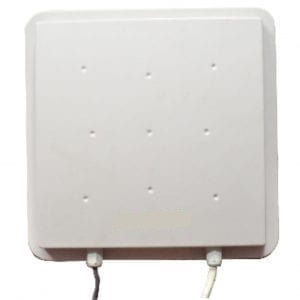
An integrated reader combines the reader electronics and antenna in one housing. Installation is simpler - one cable, often Power over Ethernet - and there is no antenna cable loss. They suit single read points such as a doorway, a vehicle lane or an office entrance. Some include an extra port for one external antenna.
Handheld readers and Android RFID mobile computers
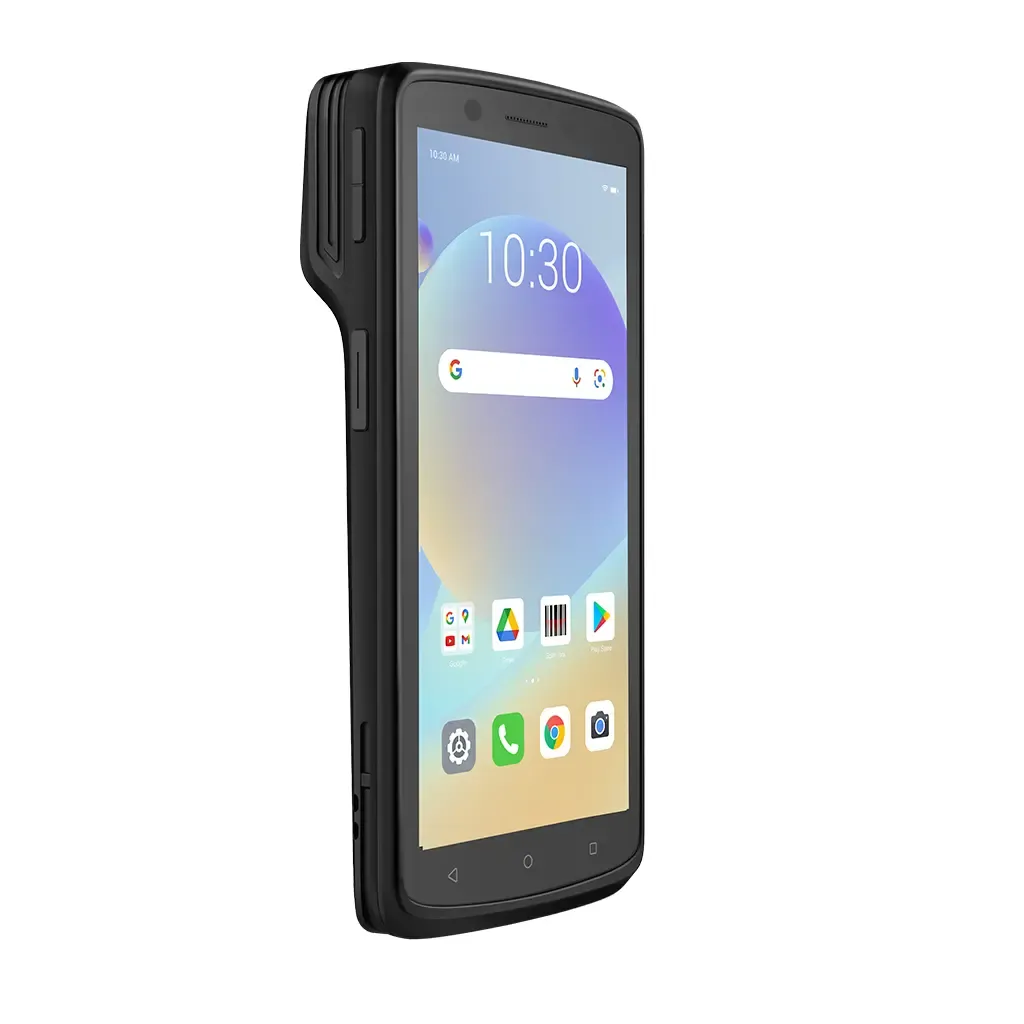
Handhelds are portable readers with a built-in antenna, battery and usually a trigger grip. Modern units are rugged Android mobile computers with an integrated UHF module, a barcode scanner, touchscreen, Wi-Fi, 4G/5G and Bluetooth. They run your inventory app directly. They are ideal for stock counts, asset audits, locating a specific item (using signal strength "geiger counter" modes) and receiving goods. See handheld RFID readers.
Bluetooth sleds
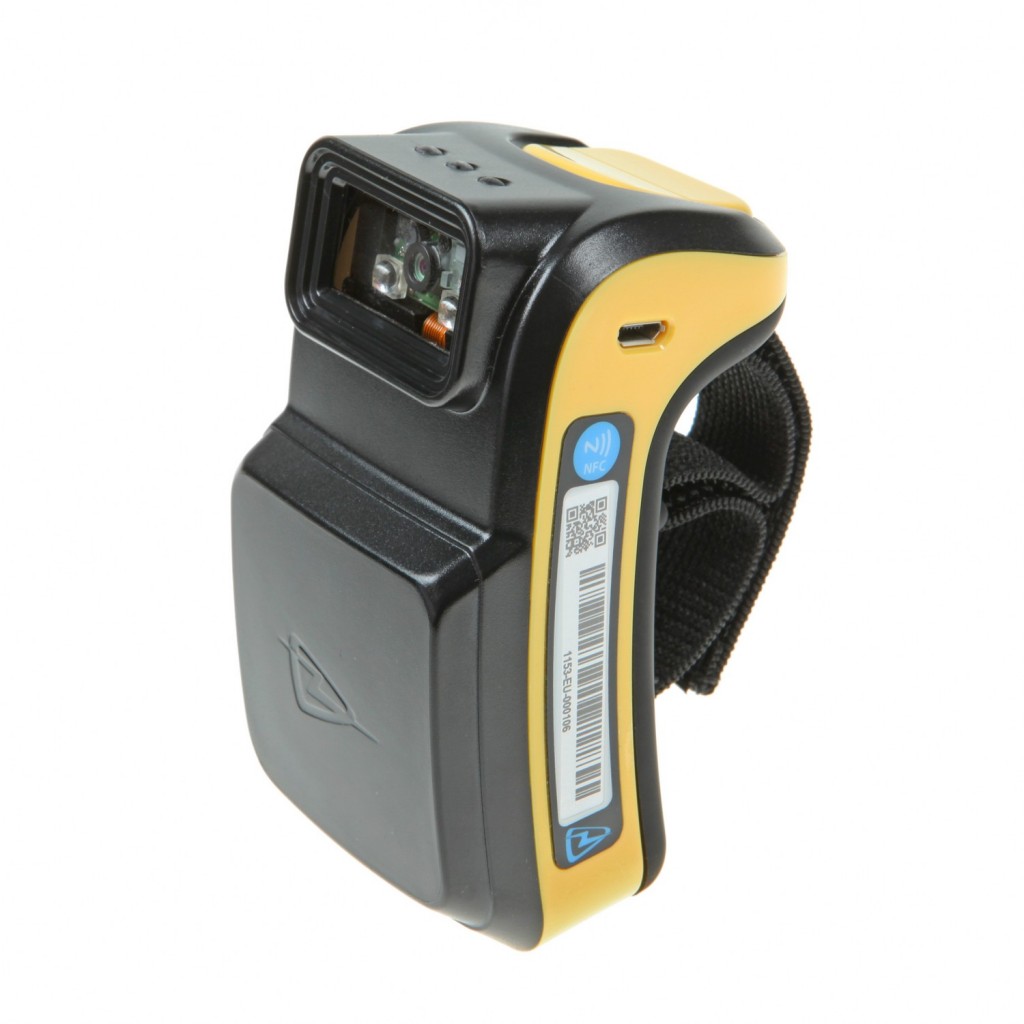
A sled is an RFID reader with a battery and antenna that attaches to, or pairs with, a smartphone or mobile computer over Bluetooth (sometimes USB). The phone provides the screen and app; the sled provides UHF capability. Sleds are a cost-effective way to add RFID to existing devices, though they add pairing and charging steps for users.
Desktop readers and encoders
Desktop readers are small, low-power units, usually connected by USB, used at a counter or workstation to read or write individual tags - for example issuing access cards, registering assets, encoding garment labels or reading library books. Their short range is deliberate, so that only the tag on the pad is read.
Embedded modules
Reader modules are bare circuit boards built into other products: kiosks, smart cabinets, vending machines, printers, gates and handheld devices. Developers integrate them through serial, USB or SPI interfaces and a vendor command set.
RFID printers as encoders
An RFID label printer contains a reader and a small antenna so it can encode each label's chip as it prints the barcode and text, then verify it and reject faulty tags. For most labelling operations, the printer is the main encoding station. See RFID Printing & Encoding.
In the real world
Reader types compared
| Reader type | Typical UHF range | Antennas | Common interfaces | Best for |
|---|---|---|---|---|
| Fixed reader (2-8 ports) | Up to about 10 m with suitable antennas and tags | External | Ethernet/PoE, USB, RS-232, GPIO, sometimes Wi-Fi | Dock doors, conveyors, portals, production lines |
| Integrated reader | A few metres to around 10 m | Built-in (plus optional external) | Ethernet/PoE, RS-232/RS-485, Wiegand on access models | Single doorways, vehicle lanes, simple read points |
| Android handheld | Typically a few metres, longer on high-power models | Built-in | Wi-Fi, cellular, Bluetooth, USB | Audits, stock counts, search, mobile receiving |
| Bluetooth sled | Similar to handhelds | Built-in | Bluetooth, USB | Adding RFID to phones and existing mobile computers |
| Desktop reader/encoder | Centimetres to tens of centimetres | Built-in | USB, sometimes Ethernet | Encoding, registration, counter-top reading |
| Embedded module | Depends on antenna and power | External or on-board | UART/serial, USB, SPI | Kiosks, cabinets, OEM devices |
| RFID printer | Very short (encoding position) | Internal | Ethernet, USB, Wi-Fi | Printing and encoding labels in volume |
Ranges are indicative for passive UHF labels; actual range depends heavily on tags, materials and environment.
Key specifications that matter
Frequency and region
UHF readers must operate on the band permitted in the country of use. In India this is 865-867 MHz; Europe uses 865-868 MHz; the USA uses 902-928 MHz. Many readers are sold in regional versions or can be set to a region in firmware. Using a reader on the wrong band can be illegal and can interfere with other services, such as mobile networks adjacent to the US band.
Output power
Conducted output power is expressed in dBm. Full-size UHF fixed readers and many handhelds can typically transmit up to about 30 dBm (1 W), adjustable in small steps. Desktop readers use far less. More power gives more forward-link range, but you rarely want maximum power everywhere - lower power is often the best way to keep a read zone tight. Remember that radiated power (including antenna gain) must stay within regulatory limits.
Receive sensitivity
Receive sensitivity is the weakest tag signal the reader can still decode, in negative dBm - more negative is better. A sensitive receiver helps in noisy environments and with small tags, and is particularly important in dense installations where many readers operate near each other. Compare vendors carefully, since sensitivity figures may be measured under different conditions.
Antenna ports
The number of ports determines how many antennas (and therefore how many read zones or angles) one reader can drive. A dock door may need two to four antennas; a conveyor tunnel may need more. Port count is a major factor in reader cost per read point.
Read rate
Datasheets quote peak read rates in hundreds of tags per second or more. These figures assume ideal conditions and simple inventory. Real throughput depends on the Gen2 settings (session, link frequency, encoding), the number of tags, reads of memory beyond the EPC and the environment.
Dense reader mode and anti-collision
All Gen2 readers use anti-collision algorithms to sort out many tags replying at once. Where several readers operate close together, dense reader mode settings help readers avoid drowning each other out. Ask about this feature for large warehouse or retail deployments.
Interfaces, protocols and GPIO
Physical interfaces
- Ethernet with PoE - the standard for fixed and integrated readers: one cable carries data and power. Check whether the reader needs standard PoE or higher-power PoE+ for full RF output.
- USB - for desktop readers, modules and configuration.
- RS-232 / RS-485 - serial links still common in industrial control and older systems.
- Wi-Fi and Bluetooth - for handhelds, sleds and some fixed readers where cabling is difficult.
- Wiegand - common on access control readers to connect to door controllers.
Software protocols
- LLRP (Low Level Reader Protocol) - a GS1 EPCglobal standard for configuring UHF readers and receiving reads over TCP/IP. Supported by many enterprise readers and middleware, it avoids lock-in to one vendor's API.
- Vendor SDKs - libraries for Java, .NET, C/C++, Android and others. They often expose features that LLRP does not, and are the usual route for handheld apps.
- MQTT, HTTP/REST, WebSocket - many modern readers can publish tag events directly to a broker or web service, and some run custom applications on the reader itself, reducing the need for a separate PC.
- Keyboard wedge / HID - desktop readers may simply "type" the tag ID into any application, useful for quick integrations.
GPIO
General-purpose inputs and outputs let a reader interact with the physical world. Inputs can trigger reading when a photo-eye or motion sensor detects a pallet; outputs can drive stack lights, buzzers, barrier gates or conveyor diverters. GPIO is how many dock door and gate systems decide direction and raise alerts. Reads are then processed by RFID middleware and software.
How to choose a reader
Work from the process, not the product catalogue:
- Where do reads happen? At a fixed point (fixed or integrated reader), throughout a building (handhelds), at a desk (desktop reader) or inside a product (module)?
- How many tags and how fast? A pallet of 200 cartons passing at forklift speed needs a different setup from one person tapping a card.
- How many antennas? Count read zones and angles; that sets the port count.
- What environment? Indoor, outdoor, cold storage, dust, vibration - check the IP rating and operating temperature.
- How will data reach your software? Check protocol support (LLRP, SDK, MQTT, REST) and whether your middleware or ERP integration already supports the reader.
- Power and network: PoE availability, Wi-Fi coverage, battery life for handhelds.
- Region and compliance: confirm 865-867 MHz operation for India.
- Support: local service, spare parts and firmware updates matter over a system's life.
Reader choice is closely tied to read range, which is the subject of the next chapter, RFID Read Range & Performance.
Watch & learn
Videos are from YouTube and their respective creators; they play only when you click.
Help India adopt this fast-growing technology - teach, consult or build projects with Indian RFID.
Frequently asked questions
What is the difference between a fixed and a handheld RFID reader?
A fixed reader is mounted permanently and connected to external antennas to monitor a zone such as a dock door. A handheld reader is a portable device, usually with a built-in antenna and screen, used for audits, searches and mobile tasks.
How many antennas can one RFID reader support?
Common fixed UHF readers have 2, 4 or 8 antenna ports, and some support external multiplexers to add more. Integrated readers have a built-in antenna and sometimes one extra port.
Can I use an imported UHF reader in India?
Only if it can be configured for the Indian 865-867 MHz band and complies with Indian rules. Readers set to the US 902-928 MHz band must not be operated in India, and tags tuned for that band may also perform worse here.
What is LLRP?
LLRP (Low Level Reader Protocol) is a GS1 EPCglobal standard that lets software configure UHF readers and receive tag reads over a network in a vendor-independent way.
Is a higher read rate always better?
Not necessarily. The quoted tags-per-second figure is measured in ideal conditions. Read accuracy - reading every tag that should be read and none that should not - matters more for most applications.
Join the 1-month Certified RFID Specialist Program - live online. New batch 12 January 2027.