RFID for Animals: Pets, Livestock & Wildlife
Animal identification is one of the oldest and most successful uses of RFID. This chapter explains how pet microchips and livestock ear tags work, the ISO 11784/11785 standards behind them, how RFID is used in dairies, fisheries, wildlife research, zoos and stray-animal programmes, and how to choose tags and readers that actually work in the field.
- Pet microchips and most animal ID tags are passive LF tags at 134.2 kHz, because LF works reliably through tissue and moisture.
- ISO 11784 defines the 15-digit animal ID number; ISO 11785 defines how it is transmitted, using FDX-B or HDX.
- A microchip is only useful if its number is registered with current owner details in a registry.
- Livestock use ear tags (LF, and sometimes UHF for longer range), boluses or collars; dairies use them to automate milking, feeding and health records.
- Choose universal ISO readers, test read range on real animals, and plan for tag loss, orientation and registry quality.
Why animals were among the first RFID users
Long before RFID reached shops and toll plazas, farmers and vets were using it to identify animals. The reasons are simple. Animals cannot carry an ID card, painted marks and brands fade or harm the animal, and printed tags get dirty, torn or chewed. A tiny passive transponder sealed in glass or plastic can last for the animal's whole life and be read in seconds, even through hair, mud and skin.
Almost all animal ID uses the low frequency (LF) band around 134.2 kHz. LF does not read far - typically a few centimetres to around a metre depending on tag size and reader - but its magnetic field passes well through water and body tissue, which defeat UHF signals. This is why the chapter on RFID frequencies lists animal tagging as the classic LF application. UHF tags do have a growing role in livestock where longer range and fast reading of many animals matter, as we will see.
Pet microchips: how they work
The chip itself
A pet microchip is a passive LF transponder - a coil of very fine wire wound on a ferrite core plus a small chip - sealed in a biocompatible glass capsule. Standard chips are typically around 2 mm wide and 12 mm long; "mini" chips of roughly 1.4 x 8 mm are used for cats, small dogs and other small animals. There is no battery. The scanner's magnetic field powers the chip, which replies with its stored number.
The standards: ISO 11784 and ISO 11785
- ISO 11784 defines the code structure: what the number means. Shown to people, it is a 15-digit number. The first three digits are normally a country code (India's ISO numeric code is 356) or, for chips not tied to a national scheme, a manufacturer code in the 900-range. The remaining 12 digits are the unique identity.
- ISO 11785 defines the air interface: how the reader and tag talk at about 134.2 kHz. It allows two methods: FDX-B (full duplex - the tag replies while the reader field is on) and HDX (half duplex - the tag charges up, then replies when the reader briefly switches its field off).
Pet chips are almost always FDX-B. Readers that claim ISO compliance should read both FDX-B and HDX.
Where the chip is implanted
For dogs and cats, the usual site is under the skin on the back of the neck, between the shoulder blades, injected with a pre-loaded sterile needle applicator. Horses and other equines are commonly chipped in the neck, in the region of the nuchal ligament. Birds, reptiles and small mammals have their own recommended sites, and implantation should always be done by a vet or trained person. After implanting, the vet scans the animal to confirm the chip reads and records the number.
Scanners
Pet scanners are small handheld LF readers with a ring or paddle-shaped antenna. The operator sweeps it slowly over the shoulders, sides and neck in overlapping passes, since chips can migrate slightly over time. Read distance is typically a few centimetres for FDX-B glass chips.
Pet registries
The chip only stores a number. Its value comes from the registry that links that number to the owner's name and phone. In many countries registration is required by law; elsewhere, including India, owners typically register through the vet, the chip supplier, a private registry or a municipal pet licensing scheme where one exists. Owners must update their details when they move or change numbers.
In the real world
Livestock: cattle, buffalo, sheep, goats and pigs
Ear tags
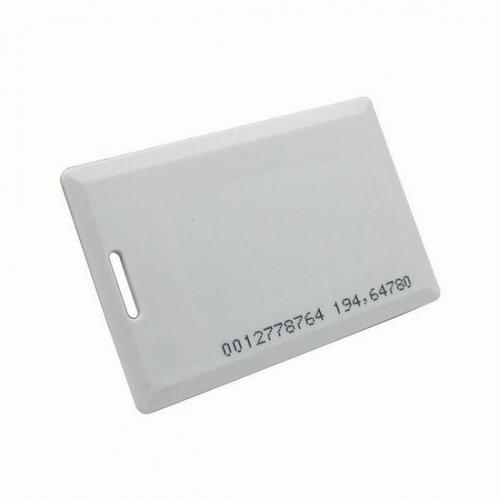
For farm animals, the most common form factor is the ear tag: a plastic tag applied with a special applicator, often as a matching pair with a printed visual tag. RFID ear tags contain an LF transponder (HDX or FDX-B) or, in some systems, a UHF EPC Gen2 inlay. LF ear tags follow ISO 11784/11785 and use the same 15-digit numbering idea as pet chips. UHF ear tags can be read from several metres and many at once, which helps when counting a moving herd, but they are more affected by moisture and animal bodies, so the tag and reader set-up must be tested carefully.
Boluses and other form factors
A bolus is a heavy ceramic capsule containing an LF transponder that is swallowed by a ruminant and stays in the forestomach for life. It is tamper-resistant and cannot be lost like an ear tag, but it must be recovered at slaughter. Dairy cattle may also wear a neck collar or leg band carrying an LF transponder, often combined with an activity sensor.
Cattle identification in India
India has one of the largest cattle and buffalo populations in the world, and government animal husbandry programmes identify animals with ear tags carrying a 12-digit animal number, linked to a national database of owners, vaccinations, breeding and health events. Many of these tags are visual or barcoded, read by field staff with a mobile app; RFID-enabled ear tags are used where automatic reading justifies the extra cost, such as organised dairies, breeding farms and research projects. The broad goal is the same as elsewhere: know which animal received which vaccine, trace disease outbreaks, support breeding and insurance, and prove ownership.
Pigs, sheep and goats
Pig farms use LF or UHF ear tags to link sows to farrowing records and to automate electronic sow feeders, which dispense a ration only when the right tag is read. Sheep and goats are commonly tagged with small LF ear tags or boluses; in large flocks, race readers log animals as they pass through a narrow lane.
Dairy and feed automation
A modern dairy is one of the best showcases of animal RFID. Each cow's transponder is read automatically at several points:
- Milking parlour: an antenna at each stall identifies the cow, so the milk meter records yield against the right animal and the system can flag abnormal milk or a cow that should not be milked (for example under antibiotic treatment).
- Feed stations: concentrate feeders read the tag and release a measured ration based on the cow's yield and stage of lactation.
- Sorting gates: after milking, a gate reads the tag and diverts cows due for insemination, a vet check or hoof trimming into a holding pen.
- Health and fertility: collars that combine an ID transponder with an activity or rumination sensor help detect heat and early illness.
Poultry, horses, fish, wildlife and zoos
Poultry and birds
Commercial broiler and layer flocks are managed as groups, so individual bird tagging is rare. It is used for breeder birds, research flocks and pedigree lines, typically with LF or HF leg bands or wing tags. Racing pigeons wear RFID leg rings read at the home loft to record arrival time.
Horses and equines
Horses are microchipped with the same ISO glass transponders used for pets, and in many countries a chip is required for the horse's passport. Chips help prove identity at races, sales, competitions and vet treatments, and support theft recovery.
Fish: PIT tags
Fisheries scientists use PIT tags (passive integrated transponders) - small glass LF tags, often 8-23 mm long - inserted into fish to study migration, growth and survival. Large loop antennas installed in fish ladders, streams and hatchery channels log each tagged fish as it swims past. Fish farms also use PIT tags to track broodstock in breeding programmes. Both FDX-B and HDX tags are used; HDX is often preferred for antenna arrays in rivers because of its range.
Wildlife research
Researchers implant PIT tags in turtles, snakes, lizards, bats and small mammals to recognise individuals when recaptured, or to log visits at burrows, nest boxes and feeding stations without disturbing the animal. RFID here only identifies the animal near a reader; tracking animals over large distances uses separate radio or GPS collars.
Zoos
Zoos microchip many animals - from big cats to tortoises - so that each individual has a permanent identity in its medical, breeding and transfer records.
Stray-animal management
In Indian cities, municipal bodies and animal welfare organisations run sterilisation and vaccination programmes for street dogs. Some programmes microchip treated dogs so that field teams can tell, with a quick scan, whether a dog has already been sterilised and vaccinated, and when. Combined with a mobile app and database, this reduces duplicate catching and gives more reliable data on programme coverage. Ear notches remain common as a visual marker; a chip adds an individual identity and history. The same logic suits gaushalas and animal hospitals.
Benefits and welfare considerations
Benefits
- Traceability: follow an animal from birth to sale or slaughter, essential for food safety and export markets.
- Disease control: during an outbreak, authorities can find which animals were vaccinated, moved or in contact.
- Ownership and theft: a permanent ID helps prove who owns a pet, horse or cow and supports recovery after theft.
- Insurance claims: livestock insurers need to link a claim to the insured animal; a unique, tamper-resistant ID reduces disputes and fraud.
- Productivity: automatic records of milk yield, feed, weight and breeding improve decisions on every animal.
Welfare
Good practice puts the animal first. Use the smallest tag that reliably reads; apply ear tags in the correct zone of the ear with a clean applicator, avoiding cartilage ridges and blood vessels; and implant chips only with sterile, single-use needles. Watch for infection, tag tearing and chip migration, and record and report problems. Avoid tagging very young animals before the recommended age for that species.
Choosing tags and readers
Matching tag to animal
| Animal | Typical tag type | Frequency | Standard / protocol |
|---|---|---|---|
| Dogs, cats, small pets | Implanted glass microchip | LF 134.2 kHz | ISO 11784/11785, FDX-B |
| Horses, donkeys | Implanted glass microchip | LF 134.2 kHz | ISO 11784/11785, FDX-B |
| Cattle and buffalo | Ear tag, bolus, neck collar | LF 134.2 kHz; UHF in some systems | ISO 11784/11785 (HDX or FDX-B); EPC Gen2 for UHF |
| Sheep and goats | Small ear tag or bolus | LF 134.2 kHz | ISO 11784/11785 |
| Pigs | Ear tag | LF 134.2 kHz or UHF | ISO 11784/11785 or EPC Gen2 |
| Breeder poultry, pigeons | Leg ring or wing tag | LF or HF | Vendor or sport-body specific |
| Fish | PIT tag (glass) | LF 134.2 kHz | ISO 11784/11785, FDX-B or HDX |
| Wildlife, reptiles, zoo animals | PIT tag or microchip | LF 134.2 kHz | ISO 11784/11785 |
Readers
- Handheld scanners and wand readers: pocket scanners for vets and shelters; long "wand" or "stick" readers for reading ear tags on cattle in a crush or pen without getting too close. See our handheld RFID readers.
- Panel readers: large flat antennas mounted on either side of a race lane, gate or weighbridge read animals walking through in single file. HDX is often chosen here.
- Integrated readers: built into milking stalls, feeders, sorting gates and scales, usually supplied by the equipment maker.
- UHF portals: where UHF ear tags are used, fixed readers at gates count groups of animals at longer range.
For other low-frequency tag formats, see our LF RFID tags, and for rugged tags used on equipment and enclosures, our RFID hard tags.
Common problems and how to avoid them
- Unregistered numbers: the chip reads, but no one knows whose animal it is. Make registration part of the implant procedure.
- Reader incompatibility: a reader that handles only FDX-B misses HDX tags, or vice versa. Buy readers that support both, and older 125 kHz formats where pets are concerned.
- Orientation and speed: LF tags read best when their coil is aligned with the reader field. Animals running fast through a race, or tags facing the wrong way, cause missed reads. Slow the lane, use antennas on both sides and test with real animals.
- Only one at a time: many LF readers cannot reliably read two FDX-B tags in the field together. Single-file lanes avoid this; UHF is the option when many animals must be read at once.
- Electrical noise: motors, variable-speed drives and electric fences can interfere with LF readers. Survey the site and keep antennas and cables away from noise sources.
- Tag loss and migration: ear tags can tear out; chips can move. Pair electronic tags with visual tags and scan the whole body when a chip is not found at the usual site.
- Duplicate or non-ISO numbers: buy from reputable suppliers whose numbers follow ISO 11784 and are unique.
Although animal RFID rarely holds personal data on the tag, registries hold owners' names and addresses, so they need the same protection discussed in RFID security and privacy. If you would like to design animal identification or dairy systems professionally, our RFID courses in India include hands-on work with LF readers and tags.
Help India adopt this fast-growing technology - teach, consult or build projects with Indian RFID.
Frequently asked questions
Does a pet microchip track my dog with GPS?
No. A pet microchip is a passive LF tag with no battery or GPS. It only reveals its number when a scanner is held within a few centimetres; GPS trackers are separate, battery-powered collar devices.
Where is a microchip implanted in a dog or cat?
It is usually injected under the skin on the back, between the shoulder blades, using a sterile applicator. Horses are commonly chipped in the neck. A vet should implant the chip and scan it immediately afterwards to confirm it reads.
What is the difference between FDX-B and HDX?
Both are ISO 11785 methods at about 134.2 kHz. FDX-B tags reply while the reader field is on and are common in pet chips; HDX tags store energy, then reply in a pause in the field, which often gives better range and noise tolerance in livestock tags and race lanes.
Can one scanner read all pet chips?
A universal ISO scanner reads FDX-B and usually HDX. Some older or non-ISO chips use 125 kHz formats, so many shelter scanners also support those to avoid missing an animal.
Are cattle ear tags in India RFID?
Government livestock identification programmes in India use ear tags carrying a 12-digit animal number, many of them visual or barcoded. RFID ear tags are available and are used by some organised dairies and projects where automatic reading is worth the extra cost.
Is microchipping painful for animals?
It is a quick injection similar to a vaccination, and most animals react only briefly. Correct technique, a sterile applicator and the right chip size for the animal minimise discomfort and complications.
Join the 1-month Certified RFID Specialist Program - live online. New batch 12 January 2027.