RFID vs Barcode vs NFC vs BLE
Barcodes, QR codes, UHF RFID, NFC and Bluetooth Low Energy beacons all identify things, but they do it in very different ways and at very different costs. This chapter compares them side by side, explains when to combine barcode and RFID on one label, and gives a simple guide for choosing the right technology.
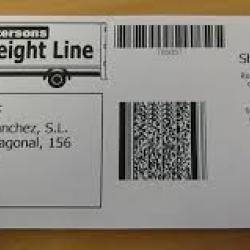
- Barcodes and QR codes are the cheapest option but need line of sight and are scanned one at a time.
- Passive UHF RFID reads hundreds of tags per second at several metres without line of sight, at a higher cost per tag.
- NFC is a subset of 13.56 MHz HF RFID designed for deliberate, very short-range taps - ideal for phones and authentication.
- BLE beacons are battery-powered and suit real-time location of people and high-value assets, not low-cost item tagging.
- Many successful projects combine technologies, most commonly a barcode and an RFID inlay on the same label carrying the same identifier.
Five ways to identify things automatically
Every automatic identification system answers the same question - "what is this item?" - but with different trade-offs between cost, speed, range and security. Here is the short version:
- 1D barcode (EAN-13, Code 128 and others) - printed lines read by a laser or camera scanner. Universal and nearly free.
- 2D codes (QR Code, Data Matrix) - printed matrices holding much more data, readable by any smartphone camera.
- Passive UHF RFID - battery-free tags in the 860-960 MHz range (865-867 MHz in India), read at several metres, many at once, without line of sight.
- HF RFID and NFC - 13.56 MHz tags read at centimetres (NFC) up to around a metre (vicinity HF), often with strong security; NFC is readable by phones.
- BLE beacons - small battery-powered Bluetooth Low Energy transmitters that broadcast an ID every fraction of a second, received by gateways or phones tens of metres away.
If you are new to RFID itself, start with What is RFID? before continuing.
Side-by-side comparison
| Feature | 1D barcode | QR / 2D code | Passive UHF RFID | NFC / HF RFID | BLE beacon |
|---|---|---|---|---|---|
| Line of sight needed | Yes | Yes | No (through cartons, plastic, fabric) | No, but must be very close | No |
| Typical read range | Contact to about 1 m (further with long-range scanners) | A few cm to about 1 m | Up to about 10-15 m with fixed readers; a few metres with handhelds | NFC 0-4 cm typical (max about 10 cm); HF vicinity up to about 1 m | Typically 10-50 m indoors |
| Bulk reading | One at a time | One at a time (some camera systems read several) | Hundreds per second | A few at a time; phones read one | Many at once |
| Data capacity | Typically 10-50 characters | Up to about 3 KB (7,089 digits in a large QR) | EPC usually 96-496 bits; optional user memory up to a few kilobits | From about 48 bytes to several KB | Broadcasts a short ID; data lives on a server |
| Rewritable | No | No | Yes (unless locked) | Yes (unless locked) | Configurable |
| Durability | Fails if dirty, scratched or torn | Better (error correction) but still visual | Works when dirty or hidden; rugged hard tags available | Works when hidden; cards and tokens are robust | Rugged, but battery lasts typically 1-5 years |
| Cost per tag (indicative) | Under ₹1; often near zero on packaging | Under ₹1 | About ₹4-20 for labels in volume; ₹50 to ₹1,000+ for hard and on-metal tags | About ₹8-40 for NFC labels; ₹30-300 for secure chips and cards | About ₹500-3,000 per beacon |
| Reader cost (indicative) | ₹2,000-25,000 per scanner | Free on smartphones; ₹4,000-30,000 for imagers | Handhelds about ₹60,000-2,50,000; fixed readers about ₹50,000-2,50,000 plus antennas | Free on smartphones; desktop readers about ₹1,500-10,000 | Gateways about ₹3,000-30,000 each; phones can listen |
| Security | None - easily copied | None unless signed or linked to a server check | Basic by default; optional crypto on Gen2v2 chips | None to strong (AES on DESFire, NTAG 424 DNA) | Basic; spoofable unless IDs rotate or are encrypted |
| Best uses | Retail POS, labelling, documents | Payments, marketing, product information, GS1 Digital Link | Inventory, supply chain, assets, tolling, races | Access, payments, phone tap, authentication, libraries | Real-time location, proximity marketing, people safety |
All prices above are indicative Indian market ranges for typical volumes and change with quantity, specification, brand and exchange rates. Ask for quotations against your actual requirement.
In the real world
Barcodes and QR codes: still the default
Barcodes have been the backbone of retail and logistics for decades for good reasons: they are printed for almost nothing, every scanner and POS system reads them, and GS1 numbering (issued in India by GS1 India) gives every product a globally unique GTIN. Their limitations are physical - a scanner must see each code, one at a time, and a smudged or torn label fails.
QR codes and Data Matrix hold far more data and include error correction, so they survive partial damage. QR codes became part of daily life in India through UPI payments, and they are excellent for linking a physical product to web content. The retail industry is also moving toward 2D codes at checkout using GS1 Digital Link, where one QR code can carry the GTIN, batch, expiry and a web link.
Passive UHF RFID: speed and scale
UHF RFID's advantage is not that it is "a better barcode", but that it changes the process. A store associate with a handheld reader can count several thousand garments in the time it would take to scan a few hundred barcodes. A dock door can verify every carton on a pallet as the forklift drives through. A FASTag lets a vehicle pass a toll plaza without anyone scanning anything.
The trade-offs are tag cost, the need for proper tag selection on metal and liquids, and the engineering required to control read zones. These are covered in RFID Read Range & Performance and Advantages & Disadvantages of RFID.
NFC: a subset of HF RFID
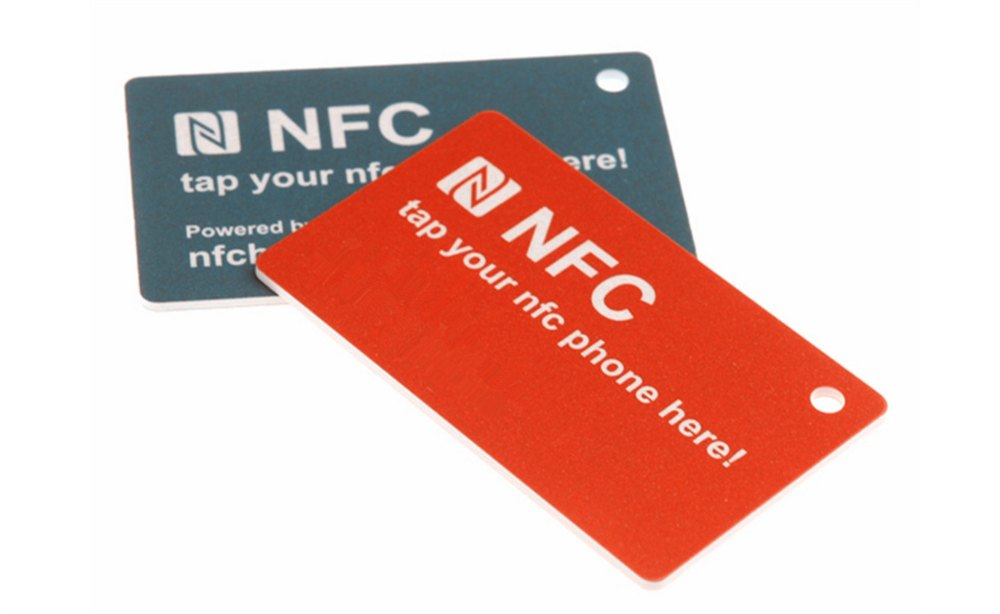
NFC operates at 13.56 MHz and is built on HF RFID standards such as ISO/IEC 14443 and ISO/IEC 15693, plus NFC Forum specifications that define tag types and the NDEF data format. In other words, all NFC is HF RFID, but not all HF RFID is NFC.
NFC's very short range is a feature, not a flaw. It means a read happens only when someone deliberately taps, which makes it ideal for payments, access control, pairing devices and consumer interaction. Its other big advantage is that billions of smartphones already contain an NFC reader, so a brand can let customers verify a product, register a warranty or reorder consumables without any special hardware.
NFC is not a good choice for counting stock on a shelf or reading pallets at a door - it is too short-range and reads one tag at a time on phones. Use UHF RFID for those jobs, or HF vicinity tags for specific applications such as libraries. Products are listed on our NFC tags page.
BLE beacons and RTLS vs passive UHF
A BLE beacon contains a battery and actively broadcasts its identity, so it can be detected continuously by gateways or phones tens of metres away. That makes BLE a common choice for real-time location systems (RTLS): tracking wheelchairs and infusion pumps in hospitals, workers in hazardous plants, or high-value tools on a large site.
| Aspect | Passive UHF RFID | BLE beacons / RTLS |
|---|---|---|
| Tag power | None - powered by the reader | Battery, typically 1-5 years |
| Tracking style | Checkpoints and zones where readers are installed | Continuous presence across the covered area |
| Location accuracy | Zone level; around a metre with array readers | Room or zone level with signal strength (often 1-5 m); sub-metre possible with BLE direction finding in good installations |
| Tag cost | Rupees per label | Hundreds to thousands of rupees per tag |
| Scale | Lakhs of items affordably | Hundreds to a few thousand high-value assets or people |
| Maintenance | Practically none for tags | Battery replacement and beacon management |
Where centimetre-level accuracy is required, ultra-wideband (UWB) RTLS is another option, typically accurate to tens of centimetres at a higher system cost. Many sites use both approaches: passive UHF on the thousands of low-cost items and BLE or UWB on the few assets or people that need live location.
When to combine barcode and RFID on one label
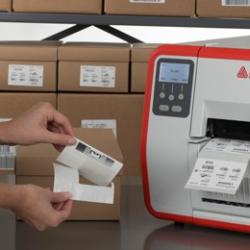
Combining technologies is common and usually smart. The most popular combination is an RFID label with a printed barcode, where both carry the same identifier - for example, the GTIN in the barcode and the matching SGTIN in the RFID chip (see EPC Encoding & Tag Memory).
- Fallback - if a tag is damaged or a reader is unavailable, staff can scan the barcode.
- Mixed partners - some customers or distributors may have RFID while others only scan barcodes.
- Phased rollout - you can start encoding RFID at source while stores and warehouses adopt readers over time.
- Human readability - the printed text and barcode let people verify the item visually.
RFID printers print the barcode and text while encoding and verifying the chip in a single pass, so dual labels add little operational effort.
Decision guide
| If you need to... | Choose |
|---|---|
| Identify items at the lowest possible cost, scanned one by one | 1D barcode |
| Link products to web content, payments or rich data viewable on any phone | QR code / GS1 Digital Link |
| Count or verify many items quickly, through packaging, at a distance | Passive UHF RFID |
| Let consumers or staff tap with a phone, or control access securely | NFC / HF RFID |
| Prove authenticity in a way that resists copying | Cryptographic NFC (for example SUN-enabled tags) or Gen2v2 authentication |
| Track library books with self-checkout and security gates | HF ISO/IEC 15693 RFID (UHF is also used in some libraries) |
| See where people or high-value equipment are right now, continuously | BLE or UWB RTLS |
| Serve partners with and without RFID at the same time | Combined barcode + RFID label |
If you are still unsure, compare real scenarios in our case studies or ask our RFID consulting team for an unbiased assessment.
Watch & learn
Videos are from YouTube and their respective creators; they play only when you click.
Help India adopt this fast-growing technology - teach, consult or build projects with Indian RFID.
Frequently asked questions
Will RFID replace barcodes?
Unlikely in the foreseeable future. Barcodes cost almost nothing to print and work everywhere, so they remain the default. RFID is added where its bulk, no-line-of-sight reading saves enough labour or loss to justify the tag cost, and the two often coexist on one label.
Is NFC the same as RFID?
NFC is a type of RFID. It operates at 13.56 MHz like HF RFID, builds on ISO/IEC 14443 and related standards, and adds NFC Forum rules so phones can read and write tags. All NFC is RFID, but most RFID, such as UHF, is not NFC.
Can my phone read UHF RFID tags?
No. Phones include NFC (HF) radios only. Reading UHF tags needs a dedicated UHF reader, which can be a handheld device or a sled that connects to a phone.
Is a QR code better than NFC for product authentication?
A plain QR code is easy to copy, so it is weak for authentication on its own. A cryptographic NFC tag such as one with SUN messages is much harder to fake. QR codes are fine for information and marketing, and some brands use both.
When should I choose BLE instead of passive RFID?
Choose BLE when you need continuous, real-time location without people walking past fixed readers, and the tagged item is valuable enough to justify a battery-powered tag. Choose passive RFID for large numbers of low-cost items or when you need checkpoint-based tracking.
Join the 1-month Certified RFID Specialist Program - live online. New batch 12 January 2027.