RFID Cost & ROI
What does an RFID system really cost, and how do you know whether it will pay back? This chapter breaks down every cost component with indicative Indian price ranges, works through a complete ROI example in rupees with stated assumptions, and shows how to build a business case that finance will accept.
- Total cost includes tags, readers, antennas, printers, software, integration, installation, training and maintenance - not just hardware.
- Tags are usually a recurring cost for consumable items and a one-time cost for reusable assets; this difference drives the economics.
- Payback period = initial investment / net annual benefit; ROI % = (total net benefit - investment) / investment x 100.
- Hidden costs such as process change, data cleaning, tag testing and parallel running must be included for a credible case.
- Reduce cost by piloting first, choosing the right tag rather than the most expensive one, and rolling out in phases.
How to think about RFID cost
People usually ask "what does an RFID tag cost?" The better question is "what does it cost to solve this problem with RFID, over the life of the system, compared with the value it creates?" Tags are only one part. A credible estimate includes every component from the site survey to annual maintenance, separates one-time from recurring costs, and is compared with measurable benefits.
Cost components
Tags
Tag cost depends on frequency, chip, antenna size, encapsulation, printing, encoding and, above all, volume. Large orders of standard labels are far cheaper per unit than small orders of custom tags.
| Tag type | Indicative price per unit (INR) | Typical use |
|---|---|---|
| UHF paper label or inlay, standard size, in volume | about 4 - 15 | Cartons, retail items, documents |
| Printed UHF garment ticket or care label | about 6 - 20 | Apparel source tagging |
| HF / NFC label | about 8 - 40 | Libraries, product authentication, smart posters |
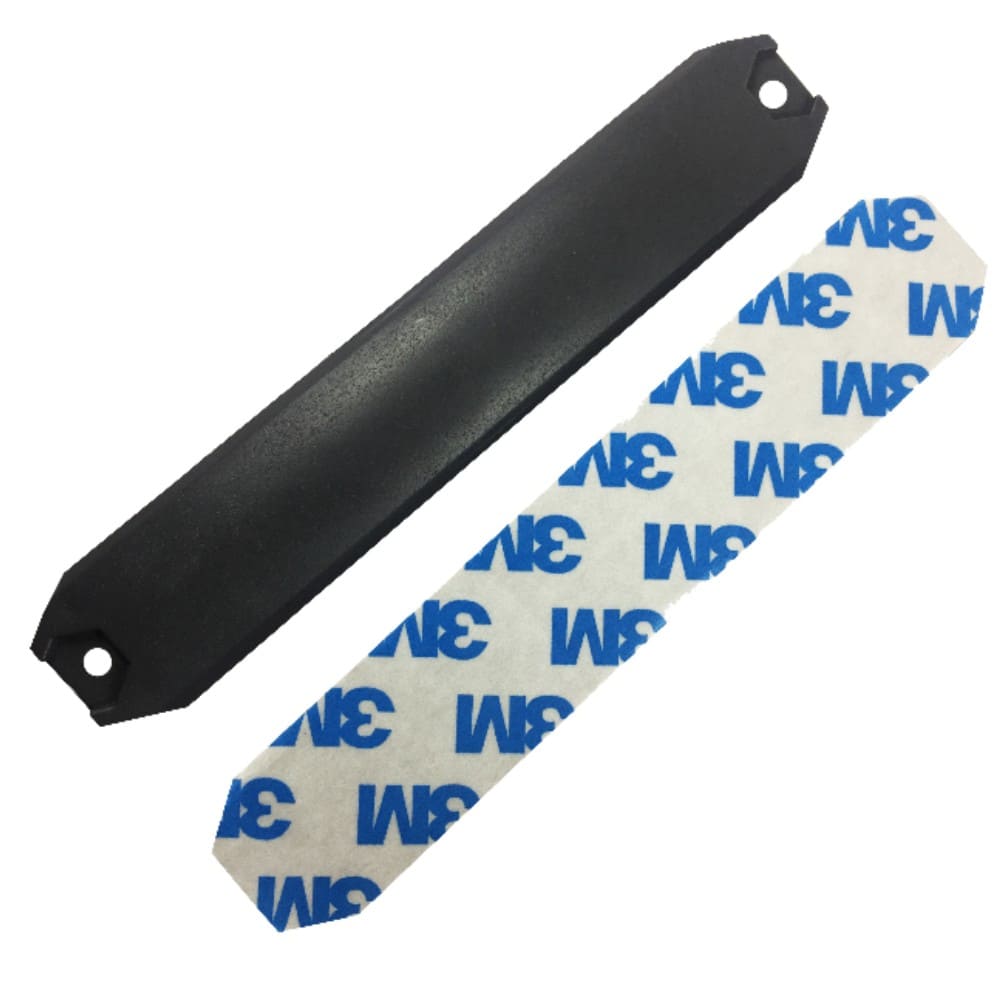
| Flexible on-metal UHF label | about 30 - 120 | IT assets, metal shelving, cylinders |
| Rugged hard tag (on-metal, industrial, high-temperature) | about 60 - 500 or more | Tools, pallets, machinery, outdoor assets |
| Laundry / textile tag | about 50 - 200 | Linen, uniforms |
| Cards and wristbands | about 20 - 150 | Access, events, patients |
| LF animal ear tag or glass transponder | about 40 - 250 | Livestock, pets |
| Active RFID tag (battery powered) | about 1,500 - 6,000 or more | Real-time location, vehicles, high-value assets |
See our UHF RFID labels and RFID hard tags ranges for options.
Readers, antennas, printers and accessories
| Hardware | Indicative price (INR) | Notes |
|---|---|---|
| Desktop / USB reader-writer | about 8,000 - 40,000 | Counters, encoding stations, POS |
| Handheld UHF reader | about 60,000 - 3,00,000 | Lower end often a sled paired with a phone; higher end rugged, long range |
| Fixed UHF reader (2-8 ports) | about 80,000 - 2,50,000 | Doors, conveyors, workstations |
| UHF antenna | about 8,000 - 35,000 each | Plus cables, connectors and mounts |
| RFID label printer-encoder | about 1,50,000 - 5,00,000 | Desktop to industrial models |
| Complete dock-door or gate portal | about 2,00,000 - 6,00,000 per door | Reader, antennas, enclosure, lights, installation |
Software and middleware
Ranges are wide: a simple standalone inventory app may cost tens of thousands of rupees, while enterprise middleware with multi-site management costs many lakhs. Pricing may be a perpetual licence plus annual maintenance, or a subscription per site, device or user.
Integration
Connecting RFID events to ERP, WMS, MES or asset systems needs analysis, development and testing. For many projects this is the largest single services cost, and it depends heavily on how open and well documented your existing systems are.
Installation, training and maintenance
Installation covers mounting, cabling, power, network points and tuning. Training covers every user group. Maintenance includes annual maintenance contracts (AMC), spares, replacement tags, software updates and periodic re-testing.
One-time vs recurring costs
| One-time (capex or project cost) | Recurring (opex) |
|---|---|
| Site survey and tag testing | Tags for consumable items (every new item needs a new tag) |
| Readers, antennas, printers, handhelds | Software subscriptions or annual licence maintenance |
| Reusable tags for assets, crates and pallets | Hardware AMC and spares |
| Software licence and configuration | Replacement tags for damaged or lost items |
| Integration development | Support staff time, re-testing, cloud or hosting fees |
| Installation and initial training | Refresher training for new staff |
The formulas you need
Keep the maths simple and transparent so anyone can check it:
- Net annual benefit = annual gross benefits - annual recurring costs
- Payback period (years) = initial one-time investment / net annual benefit
- ROI % over N years = (net annual benefit x N - initial investment) / initial investment x 100
These simple formulas ignore the time value of money. For larger investments, finance teams will also want net present value (NPV) or internal rate of return (IRR), which discount future benefits; the inputs are the same.
Worked ROI example: returnable crate tracking in a warehouse
A food distributor's warehouse ships goods to its distributors in returnable plastic crates. Crates go missing, dispatch is counted by hand, and distributors dispute how many crates and cartons they received. The company considers UHF RFID tags on every crate, two dock-door portals and two handheld readers.
Assumptions
- Crate fleet: 20,000 crates; replacement cost Rs 450 per crate.
- Current loss rate: 12 percent per year (2,400 crates). Target with RFID: 4 percent (800 crates).
- Manual counting and reconciliation today: 3 staff at Rs 25,000 per month each; with RFID, 1 is needed and 2 are redeployed to other work.
- Short-shipment claims and disputes avoided: Rs 2,00,000 per year.
- Crate tag: rugged UHF tag at Rs 40 each, buying 22,000 including 10 percent spares.
One-time investment (indicative)
| Item | Calculation | Amount (Rs) |
|---|---|---|
| Crate tags | 22,000 x 40 | 8,80,000 |
| Tag application labour | 20,000 x 3 | 60,000 |
| Dock-door portals | 2 x (reader 1,80,000 + 4 antennas 60,000 + cabling, mounts, lights 60,000) | 6,00,000 |
| Handheld readers | 2 x 1,50,000 | 3,00,000 |
| Software and ERP integration | Estimate | 6,00,000 |
| Site survey, installation, training, pilot | Estimate | 1,60,000 |
| Total one-time investment | 26,00,000 |
Annual recurring cost (indicative)
| Item | Amount (Rs per year) |
|---|---|
| Software subscription / licence maintenance | 2,50,000 |
| Hardware AMC and spares | 1,00,000 |
| Tags for replacement crates and damaged tags | 50,000 |
| Total recurring cost | 4,00,000 |
Annual benefits (assumed)
| Benefit | Calculation | Amount (Rs per year) |
|---|---|---|
| Fewer crates lost | (2,400 - 800) x 450 | 7,20,000 |
| Counting labour redeployed | 2 x 25,000 x 12 | 6,00,000 |
| Disputes and short-shipment claims avoided | Assumption | 2,00,000 |
| Total gross benefit | 15,20,000 |
Results
- Net annual benefit = 15,20,000 - 4,00,000 = Rs 11,20,000
- Payback period = 26,00,000 / 11,20,000 = about 2.3 years (roughly 28 months)
- 3-year ROI = (11,20,000 x 3 - 26,00,000) / 26,00,000 x 100 = about 29 percent
- 5-year ROI = (11,20,000 x 5 - 26,00,000) / 26,00,000 x 100 = about 115 percent
Sensitivity check
Always test what happens if your assumptions are too optimistic. If the loss rate falls only to 8 percent instead of 4 percent, crate savings drop to (2,400 - 1,600) x 450 = Rs 3,60,000. Gross benefit becomes Rs 11,60,000, net annual benefit Rs 7,60,000, and payback stretches to about 3.4 years (roughly 41 months), with a 3-year ROI of about -12 percent and a 5-year ROI of about 46 percent. The project still pays back within five years, but less convincingly - exactly the kind of insight a pilot should confirm before you commit.
Note also that the labour benefit is real only if the two staff are actually redeployed to productive work or not replaced when they leave. If they stay on the same task, that line disappears.
A note on item-level tagging economics
When every item carries a consumable tag, compare the tag cost with the item's margin, not just its price. For example, a Rs 8 tag on a garment selling at Rs 1,200 with a 40 percent gross margin (Rs 480) consumes about 1.7 percent of that item's margin. The project pays only if improved availability, fewer losses and labour savings add more gross profit than the tags plus the system cost. This is why item-level tagging is common in apparel, footwear, electronics and jewellery, and rare for very low-value, low-margin goods.
Hidden costs to include
- Tag testing and samples - several tag types and placements, sometimes repeated.
- Master data cleaning - fixing duplicate or wrong item and asset records before tagging.
- Initial tagging effort - tagging existing stock or assets, often in a short window.
- Process change and parallel running - staff time while old and new processes overlap.
- Civil and electrical work - power points, network cabling, mounting structures, enclosures.
- Infrastructure changes - Wi-Fi coverage for handhelds, servers or cloud hosting.
- Exceptions handling - staff time to resolve missed or unexpected reads.
- Hardware refresh - readers and handhelds have finite life; plan for replacement over a five-year horizon.
- Internal project time - managers and IT staff spend time on the project even if no invoice is raised.
How to build a business case
- State the problem in numbers: losses, labour hours, errors, lost sales, penalties.
- Measure the baseline for each KPI over a representative period.
- List every cost using the components above, split into one-time and recurring, with quotes where possible.
- Estimate benefits conservatively, and show which are hard savings (cash) and which are soft (time, service).
- Calculate payback and ROI with the simple formulas, and NPV if finance requires it.
- Run a sensitivity check on the two or three assumptions that matter most.
- Propose a pilot with success criteria that will validate those assumptions before full investment.
The implementation guide explains how to structure that pilot, and the chapter on advantages and disadvantages helps you present risks honestly.
Ways to reduce RFID cost
- Pilot first. Spending a small amount to learn which tag, antenna layout and process works avoids buying the wrong thing in bulk.
- Choose the right tag, not the most expensive one. Select the lowest-cost tag that meets your tested performance target. A premium industrial tag on a carton that is shipped once is wasted money.
- Roll out in phases. Start with the process or site with the clearest payback and let early savings fund the next phase.
- Reuse tags where possible on crates, pallets, totes, assets and textiles.
- Tag at the right level. Case or pallet tagging may deliver most of the value at a fraction of item-level cost.
- Use handhelds before fixed infrastructure where periodic counts are enough.
- Buy labels at sensible volumes with standard sizes, and consider supplier source tagging.
- Standardise on one tag specification and one reader configuration across sites.
If you would like help estimating costs and benefits for your own operation, our RFID consulting team can prepare an independent business case.
Watch & learn
Videos are from YouTube and their respective creators; they play only when you click.
Help India adopt this fast-growing technology - teach, consult or build projects with Indian RFID.
Frequently asked questions
How much does an RFID tag cost in India?
Indicatively, a plain UHF paper label costs a few rupees to around fifteen rupees in volume, while rugged on-metal, laundry or industrial tags cost tens to hundreds of rupees. Prices depend on volume, chip, size, printing and market conditions, so always get a current quote.
What does a complete RFID system cost?
It varies enormously with scope. A small handheld-based inventory setup may cost a few lakh rupees, while a multi-site enterprise deployment can run into crores. Use the cost components in this chapter to estimate your own project.
What is a good payback period for RFID?
Many organisations look for payback within about two to three years for operational technology, but the right threshold is set by your own finance policy. Reusable-asset projects often pay back faster than item-level tagging of low-value goods.
Is RFID software a one-time or recurring cost?
Either. Some software is sold as a perpetual licence with annual maintenance, and much is now sold as a subscription per site, device or user. Compare total cost over three to five years, not just the first-year price.
Can we reduce RFID costs by buying cheaper tags?
Only if the cheaper tag passes testing on your items. A tag that reads poorly forces manual rework and erodes the entire benefit, so choose the lowest-cost tag that meets your tested performance target.
Join the 1-month Certified RFID Specialist Program - live online. New batch 12 January 2027.