Passive vs Active RFID (and Where BLE Fits): Choosing the Right Tracking Technology
posted on: 15 Oct, 2026 | 06:27:51 PM by Indian RFID
"Can RFID tell me where my asset is right now?" The honest answer is: it depends on whether you mean passive or active RFID. The two share a name but work in very different ways, cost very different amounts, and solve different problems. Mixing them up leads to projects that are either overpriced or unable to deliver what was promised.
How passive RFID works
A passive tag has no battery. It wakes up only when a reader sends energy to it, and it replies by reflecting part of that energy back (backscatter in UHF, load modulation in HF). Because there is no battery, passive tags are:
- Cheap enough to put on individual items such as garments, books and cartons.
- Thin and light - available as labels, inlays and small hard tags.
- Long-lived, limited mainly by physical damage rather than power.
The limitation is that a passive tag is only "seen" when it passes within range of a reader. That is perfect for checkpoints - a dock door, a store exit, a production station, a handheld inventory sweep - but it does not give continuous location unless you invest in dense reader infrastructure.
How active RFID works
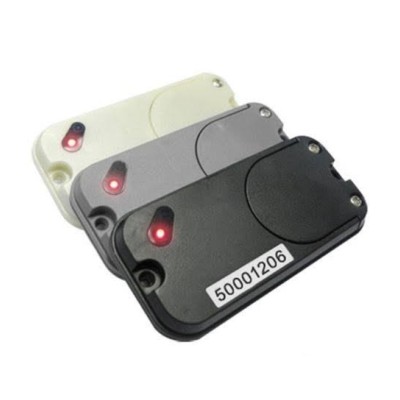
An active tag contains a battery and its own transmitter. It broadcasts periodically, or responds when interrogated, over much longer distances than passive tags. Active systems are typically used for:
- Tracking vehicles, containers and heavy equipment across a large yard.
- Monitoring high-value mobile assets such as medical equipment across a campus.
- Applications needing sensor data, for example temperature, sent continuously.
The trade-offs are cost per tag, larger size, battery replacement or tag replacement after a few years, and the need for a receiver network.
Battery-assisted passive (BAP)
In between sit battery-assisted passive tags. The battery powers the chip (and often a sensor or logger), but the tag still communicates by backscatter like a passive tag. This improves sensitivity and read reliability and allows features like data logging, while using the same type of readers as passive UHF. BAP tags are common in cold-chain and specialised logistics.
Where Bluetooth Low Energy fits
BLE beacons are not RFID in the strict sense, but they often compete for the same "where is my asset" projects. A BLE tag broadcasts to gateways or smartphones, and location is estimated from signal strength. BLE infrastructure can be cheaper to deploy than active RFID, and phones can act as readers. Many real-world systems combine both: passive UHF for item-level inventory and BLE for locating a smaller number of mobile, high-value assets.
Comparing the options
Cost per tag
Passive is the lowest by a wide margin, which is why it is used at item level. Active and BLE tags cost many times more and are reserved for higher-value assets.
Range
Passive UHF gives a few metres to around ten metres with fixed readers in good conditions. Active and BLE can cover tens of metres or more.
Visibility
Passive gives event-based visibility (item passed a point, item was counted). Active and BLE can give near-continuous presence and approximate location.
Maintenance
Passive tags need no maintenance. Battery-powered tags need monitoring and eventual replacement.
Choosing for your use case
- Thousands of low-value items, counted periodically - passive UHF.
- Items that move through known checkpoints - passive UHF with fixed readers at those points.
- A few hundred mobile, high-value assets that must be found quickly - active RFID or BLE, possibly with passive tags for audits.
- Goods requiring temperature history - BAP or sensor tags.
- Vehicles entering and leaving a gate - passive UHF windshield tags are usually sufficient; active tags are used where very long range is required.
A common mistake to avoid
Many buyers start by asking for real-time location of everything. When they see the cost of active tags and infrastructure, the project stalls. A better approach is to ask what decision you need to make and how often. If knowing that an item passed the dispatch door is enough, passive RFID delivers it at a fraction of the cost. Our case studies show how checkpoint-based passive designs handle most warehouse and retail needs.
Indian RFID can help you compare passive, active and BLE options for your site and design a mix that fits your budget. Share your asset list and site layout on WhatsApp +91-9717122688 or email gm@indianbarcode.com to start the discussion.
Contact Indian RFID
Indian RFID is the RFID arm of Mindware, which also delivers complete barcode solutions, barcode labels and the full range of Mynds brand barcode ribbons.
Phone / WhatsApp: +91-9717122688
Email: gm@indianbarcode.com
Send your requirement