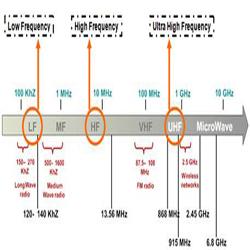
LF, HF, NFC or UHF RFID? A Practical Guide to Choosing the Right Frequency
posted on: 15 Oct, 2026 | 06:25:51 PM by Indian RFID
The first technical decision in almost every RFID project is the frequency band. It decides how far tags can be read, how many can be read at once, how well they cope with metal and liquids, and what a tag will cost. Picking the wrong band is the most common reason a pilot "does not work", even when the hardware itself is perfectly fine. This guide walks through the four bands you will meet in India and where each one makes sense.
Low Frequency (LF) - 125 kHz and 134.2 kHz
LF RFID is the oldest of the common bands. Readers couple with tags through a magnetic field, so read range is short - typically a few centimetres up to around 10 cm for handheld readers. Data rates are slow and you can only read one tag at a time.
So why is it still used? LF behaves well near water, body tissue and some metals, which is why it has long been used for animal identification, older proximity access cards, key fobs and some industrial tool tracking. If your building already runs 125 kHz access cards, there is no reason to rip them out - but for new inventory projects, LF is rarely the right answer.
High Frequency (HF) - 13.56 MHz
HF also uses magnetic coupling, with a practical read range of a few centimetres up to roughly a metre with larger fixed antennas. It has well-established standards:
- ISO 14443 - used by contactless smart cards such as MIFARE family cards for access control, transit and payments.
- ISO 15693 - "vicinity" cards and tags with a little more range, widely used in library systems (ISO 28560 defines library data models on top of it).
HF is a good choice when you want deliberate, close-range interaction - a person tapping a card, a librarian placing a stack of books on a pad, or a lab sample being read on a bench - and you specifically do not want neighbouring items to be read by accident.
NFC - a special case of HF
Near Field Communication runs at 13.56 MHz and is built on HF standards. The difference is the ecosystem: almost every modern smartphone can read and write NFC tags such as NTAG213 or NTAG215. That makes NFC ideal for consumer-facing applications - product authentication, warranty registration, digital product information, smart posters and visiting cards - where you cannot expect the end user to own a dedicated RFID reader. Range is deliberately very short, usually under 4-5 cm.
Ultra High Frequency (UHF) - RAIN RFID
UHF passive RFID, often branded RAIN RFID, uses radio waves rather than magnetic coupling. The tags follow EPC Gen2 (ISO/IEC 18000-63). In India the permitted band is 865-867 MHz; in Europe and Russia, readers operate in the 865-868 MHz band. Most modern inlays are tuned to work across global UHF bands, but your readers must be set to the local regulation.
UHF is what makes large-scale inventory automation possible:
- Read range of several metres with fixed readers and antennas, and a metre or more with handhelds.
- Hundreds of tags can be read per second thanks to Gen2 anti-collision.
- Low-cost inlays and labels make item-level tagging of garments, footwear and retail goods economical.
- Each tag carries a globally unique EPC, often encoded as a GS1 SGTIN-96.
The trade-off is sensitivity to the environment. Metal reflects UHF energy and water absorbs it, so tag selection and placement matter much more than with HF. Special on-metal tags and careful antenna planning solve most of these issues.
Quick comparison by application
- Garment and retail inventory, warehouse pallets and cartons, vehicle access: UHF.
- Jewellery stores: usually UHF for bulk stock counting, with small tags designed for jewellery.
- Library books: HF (ISO 15693 / ISO 28560) is traditional; UHF is increasingly used where faster inventory is needed.
- Employee ID and access control: HF smart cards, sometimes LF in older installations.
- Consumer engagement and authentication: NFC.
- Livestock and certain industrial tools: LF.
Questions to answer before you choose
- How far away will the reader be from the tag, and is that distance fixed or variable?
- Do you need to read one item at a time, or a whole box, rack or room at once?
- What is the item made of - fabric, paper, plastic, metal, or something containing liquid?
- Who will read the tag - your staff with dedicated readers, or customers with phones?
- Will tagged goods travel abroad, where your buyer may already use a specific band and data standard?
If you can answer these clearly, the frequency choice usually becomes obvious. When it is not obvious, a short sample test with two or three candidate tags on your actual product is the quickest way to decide. You can read about how we approach real projects on our case studies page.
Getting it right first time
Indian RFID supplies LF, HF, NFC and UHF tags, cards, inlays and readers, along with the software to tie them together, so we have no reason to push one band over another. Our job is to match the technology to your process.
Not sure which frequency fits your project? Send us a short description of your items and process on WhatsApp at +91-9717122688 or email gm@indianbarcode.com, and we will suggest suitable tags and readers for testing.
Contact Indian RFID
Indian RFID is the RFID arm of Mindware, which also delivers complete barcode solutions, barcode labels and the full range of Mynds brand barcode ribbons.
Phone / WhatsApp: +91-9717122688
Email: gm@indianbarcode.com
Send your requirement